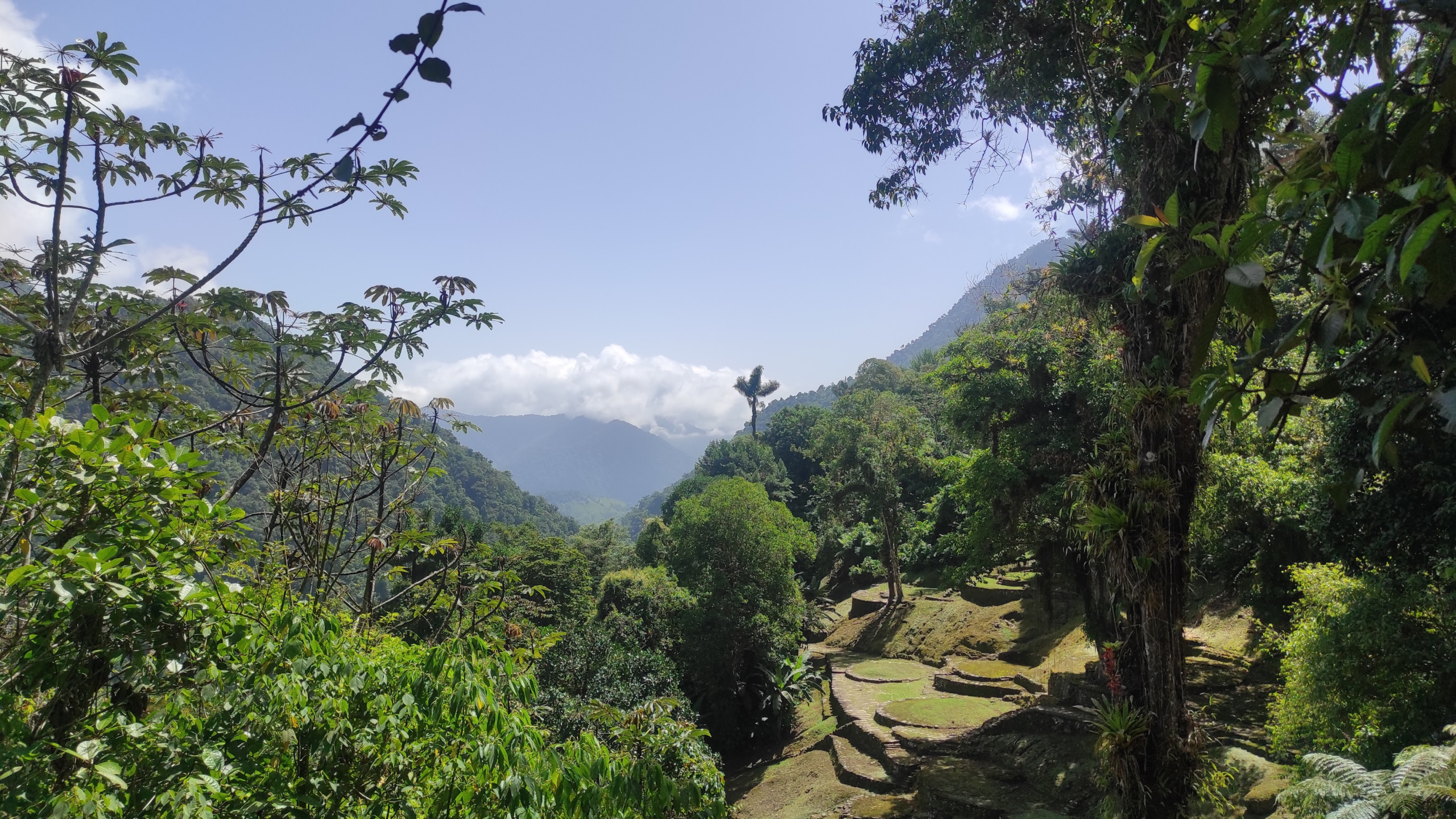
Surrounded by an endless jungle of seemingly infinite shades of green covering every single available surface of the ground, enhancing the already incredible biodiversity of the Sierra Nevada, the air practically bursting with humidity under a strong, but nourishing, sun. Butterflies the size of my hand with turquoise blue wings fluttered across the path between a collection of exquisite plants, doing their best to preserve the delicate balance of the ecosystem of the selva.
The Mamo lifted his head up gently, staring at us with a mixture of curiosity and seriousness. Or it might have been a sense of tranquility beyond what his ‘younger brothers’ could perceive, his spiritual aura creating an almost imperceptible sense of separation among their community and ours. His face was old and young at the same time, a light shade of chocolate, wrinkled at the forehead and the neck, but radiating a special sense of tranquility. He’s got a hand-woven natural bag across his chest, each of them made by the strong fibres of a native plant, with all the pigments extracted by other plants and flowers in the area. Made by the women of the community, each bag takes between 8 and 10 days to be woven. He had long, straight black hair and matching eyebrows over his slightly slant eyes. His white, breezy clothes were slightly stained by the red soil, evidence of a life spent within the heart of nature, moment to moment and day to day.
Their communities lodged high up in the forests of the Sierra Nevada de Santa Marta, about a day hiking away from the nearest ‘campesino’ communities, where the road gives way to a muddy path accessible only to those brave enough to follow its every step and get immersed in the whirlwind of its mysteries. The heart of nature within the Wiwa community had now opened up to welcome a group of sweaty hikers, gifting us the incredible opportunity to meet those whose existence is inextricably connected with nature.

…
Growing up, the world ‘jungle’ always sparked a collection of magical sounds in my mind, leaving me full of awe and a deep-seated desire to immerse myself in it and unravel its secrets. I’d always imagined the jungle as a rich place, radiating life across all directions, plants climbing on top of each other in search of light, animals competing for attention by mother nature, and monkeys swinging from branch to branch high up, almost defying the rules of physics.

But the Sierra Nevada is not only a home to jaguars, pumas, monkeys and beautiful birds and insects, but also to four different indigenous communities. The Kogi, Arhuaco, Wiwa and Kankuamo are all descendants of the Tayrona people who used to live in the Sierra. Their lives are intertwined, engaging in trading with each other and sharing spiritual traditions and beliefs, but their languages, clothing and traditions differ. These communities are self-governed jointly by an administrative leader working in collaboration with a spiritual leader, the Mamo.
The Mamo of the Wiwa community welcomed us in a traditional house in the area. Maybe not exactly welcomed, but rather made space for us to enter their lives and get a brief flavour of their lifestyle. The sense of welcome was different from what I had experienced before, with the Mamo waiting patiently and quietly on the far end for all of us to sit around the wooden benches that stood in the perimeter of the rectangular house. The selection of a rectangle is not random, as each side corresponds to each of the four communities peacefully inhabiting the Sierra. His reactions were gathered and discreet, almost mirroring the core belief that sits at the centre of the Tayrona people: that of harmony with the natural world, awareness of our place in earth and respecting the incredibly delicate ecosystem that embraces us.

As we all sat in the roughly constructed wooden benches, slightly uncomfortable and definitely aware of our unspoken but limited welcome within the community, my curiosity was excited by a narrow wooden tube held by the Mamo, about the length of my forearm, looking a bit like a pipe. Its exterior was scratched in horizontal straight lines, each leaving a gentle beige trace on the grey-green exterior, like an intricately carved sculpture. Every so often, the Mamo would gently pick up the thick stick that laid inside it, just like a pestle in a mortar. Its tip was covered in a white powder, and he would bring it in his lips, softly dabbing the end and letting the powder dissolve in his tongue. The motion had a rhythm to it, one of someone who had done this movement hundreds, if not thousands of times, enough to become as familiar as one’s palms.
The ‘poporo’ is one of the core spiritual aspects of the Wiwa, and the white powder inside it is a mixture of crushed seashells and dried coca leaves. It is only used by men in the community and is acquired during a special 4-day spiritual ceremony during which the men consume coca and tobacco, along with minimal amounts of water. After the ceremony, the adolescents in their mid-twenties can now be considered men, and their poporo holds a sacred importance for them. The first poporo stays guarded and out of public view within the house, its spirituality maintained intact from external influences. Acting similarly to a passport, it’s intertwined with the person holding it and is in fact so sacred that if they come to lose it at any point later in their life, they will inform the Mamo and go through the ceremony again, in order to acquire a new one.

The coca leaves, used by a variety of indigenous populations across Colombia, have a stimulation effect similar to that of coffee, but one of gentler and slower release. The coca leaves are picked up from the plants all around the Sierra Nevada, usually by the women and girls in the community. I was struck with awe at the dual nature of coca: the plant that, through processed output of cocaine, has signed the name of Colombia in blood in the collective psyche. But in its pure form, coca plays a critical role for numerous indigenous populations across the country, and its use extends back for hundreds of years, offering a wisdom and clarity beyond its associations with cocaine. The importance of the coca is also reinforced by the fact that the indigenous communities greet each other not in the form of handshakes, kisses or hugs, as many of us are accustomed, but rather by exchanging a few coca leaves between them, picking up some leaves from their bags and putting them in the bag of the other person.
‘As for the seashells,’ the Mamo continued shedding light into their unique traditions, ‘don’t think of course, that we pick the seashells up ourselves. We get them from the Kogi who live closer to the sea, in places like Palomino, further up the Caribbean coast from Santa Marta. We know the sea is near of course, but imagine… I hadn’t seen the sea until I was 30…’, he concluded and sat down, picking up the poporo in his hand and starting to rhythmically tap the stick within it.
In the fire that is always burning in the centre of the house, even amidst the high heat of the mountains, a stone is heated up, and is then used to simultaneously dry and crush the coca leaves within a hand-crafted bag. Similarly, the seashells are burnt, not manually crashed.

‘You see, the outside is always carved, over and over… that’s because our language is only spoken, not written. So we need this to concentrate our mind, to focus on something, just like you would do with writing’, the Mamo goes on to explain the markings I’d spotted on the outside of the poporo. It seems to me not only an ingenious idea, to concentrate the mind on the repetitive motion of scratching the outside of the poporo with the stick, but also a way to return to the reality of the moment just as it is, and observe it, fully. This is something that the younger generation observes and then eventually picks up when their turn comes, and for the duration of the expedition, I kept observing men of all ages gently scratching away at the poporo. However, what was more fascinating for me was the fact that, the scratchings on the poporo can be spiritually interpreted by the Mamo, who is the only one authorised to examine a person’s poporo and understand, by the shape of the markings, the quality of thoughts and emotions harboured by the person.
All the time the Mamo was talking, my attention kept jumping between him and the house we were at, trying to carve every small detail in my memory. The house was a structure consisting of wooden branches around the perimeter and dried leaves on the roof, hanging from smaller tree branches just like hangers on a rail. On the one hand, the sharpness and tranquility in the Mamo’s eyes, maybe as a result of the stimulation provided by the coca and the alkaloids, encapsulated a completely different way of life. One where life is centered around spiritual practices and traditions, with clearly defined roles and responsibilities for women and men, and a connection with nature beyond limits.
For the Tayrona people, the earth is the mother of the world: ‘Seneca’ or ‘Mama Yuisa’, and the sun is the god: ‘Serankua’.
‘Si no hay sol, no hay vida. Si no hay tierra, no hay vida.’
Without the sun, there is no life. Without the Earth, there is no life. A statement so straightforward, so easy to articulate, but evidently incredibly difficult to abide by in our consumerism-central world. Although technology has diluted the life of the indigenous communities in the Sierra, with the presence of technology and the internet, the respect and caring of nature is upheld to its highest regard, making me wonder how they perceive the rest of the world and its frequent disconnection from the essence of life.
Behind the Mamo I can make out a handmade flute, made out of bee wax and feathers of the condor. In my mind’s eye, I can almost see the drums playing and the flute hearing during the spiritual ceremonies conducted by the Wiwa, under the spiritual aegis of the Mamo, his future descendants diligently observing and learning. I’m curious how the Mamo is determined, and I’m interested to hear that it runs in a heritage line. The Mamo is allowed up to two wives and tends to have multiple children. From early on, he can usually see which of them have the potential to become spiritual leaders, but they are all given the opportunity to learn the art of being a spiritual leader.

‘The younger brothers’, the Mamo goes on, as if having read my questioning mind, ‘don’t know how to respect the earth… They take, they take, and never give anything back…The older brothers are trying to protect the Earth, offering back gold, protecting the nature, and meditating, for a pure mind’.
A knot of uneasiness took shape in my stomach as the Mamo’s phrase echoed through our hearts and beyond. What the Mamo meant was that we, the communities of modern civilization, are the younger brothers who seem to be treating the Earth as if it all belongs to them, while the older brothers are the indigenous communities, whose experience and wisdom are maintaining the Earth’s vitality.
The stark contradiction between the carelessness of the ‘younger’ brother and the wisdom of the ‘older’ brother kept replaying in a loop in my mind, long after we said goodbye to the Mamo and followed the path that headed deeper and deeper into the Sierra Nevada de Santa Marta.
May we all aim to keep the spirit of the older brother in our minds, centering our lives around a meaningful spiritual connection with ourselves and the world, showing respect towards nature and giving back to mother Earth, just like she gives to us.
