No one really knew how best to get me down to Mweka Gate, where our van would be waiting to take us back to whichever was the nearest hospital. Someone’s hands – it must have been Hunter’s – suddenly wrapped around my tired body and lifted me up. My head lolled from side to side as I was mounted on his back just like an oversized baby. Had they decided I was going to be piggybacked six kilometres down Africa’s highest mountain?
…
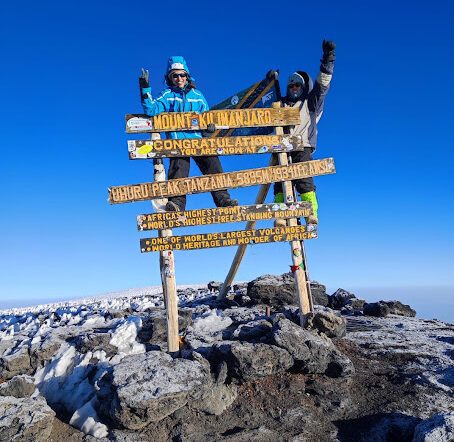
We had returned to Barafu Campsite about 24 hours earlier, after a gruelling overnight hike to the sky-scraping 5,895m summit of Kilimanjaro, the ‘Top of Africa’. Barafu Campsite was the highest of many in the mountain, and snow – ‘barafu’ in Swahili – covered the neighbouring peaks around us like a rugged blanket. The air blew crisp but gentle, a welcome change after the piercingly cold atmosphere that had surrounded us at the summit. There was still about 3,000m to descend to get to the entrance of the national park, but the campsite vibrated with the energy of tens of aspiring mountaineers who had completed the most demanding segment of the expedition, leaving the uninviting glaciers behind.
My hiking partner, Ander, and I had met a few weeks earlier whilst volunteering in a small primary school in Machame, one of the villages scattered around the slopes of the mountain. We bonded over our love of travelling and adventure, and decided to tackle Kilimanjaro together, armed with perseverance and excitement. We were sharing a tent, and our guide, porters and cook were camped next to us.
After a triumphant welcome by our porter team, we decided to have a much-needed bite of food and put our heads down in the relative warmth of the tent for a couple of hours, before hiking down to the last campsite of our trek, Mweka Camp. Although a three-course meal had been served by our porter team the previous night, I had only mustered half a bite of bread due to altitude-induced lack of appetite, a common side-effect of extreme altitude.
It felt like only a minute but must have been a couple of hours when Hunter’s hoarse voice slipped through the thin lining of the tent. He was our expedition guide, a joyful, lanky guy who had summited Kilimanjaro a whopping 50 times.
‘Mambo guys?’ he came in with that thick Tanzanian accent which I loved, ‘weather’s looking poa, let’s make a move guys.’
Good weather – or rather, stable weather – is never guaranteed in Kilimanjaro, so we had to seize the opportunity. Rubbing sleep off our eyes, we pulled ourselves together and within an hour we were on our way to Mweka Camp. At an altitude of 3,100m, it would be the last sleepover in our 6-day expedition.
Lack of sleep, persistent exertion and challenging oxygen levels in the atmosphere seemed to distort time like an optical illusions mirror. After hours of symphonies of local Chagga songs and the rhythmic rubbing of our hiking boots against the black volcanic rocks, we were finally entering Mweka Camp with a smile on our faces.
That was it – we had made it. We had successfully hiked up and (nearly) down Kilimanjaro, an extreme altitude mountain which could push even experienced mountaineers to their limits. As the aroma of freshly steamed rice wafted through the air, mingled with the earthy scent of spices that Hassan, our cook, worked wonders with, I spotted the muddy path we would tackle the following morning. Dinner was served in a circle, with the excitement of the day palpable in the air, echoing through the lively conversations that filled our hearts with unshakeable confidence. The moon was rising in the sky and at that moment, we felt invincible.
…
Slowly, I opened my eyes. Ander was still asleep and the early morning light was playing gracefully with the leaves of the guava trees that surrounded our tent. It was just a few minutes past five, my phone screen said. Why was I up so early? Then I remembered – a sharp pain had hit me in the stomach like a punch knocking the air out of me. Juggling out of my sleeping bag still half asleep, I fumbled my way out of the tent, hands clutching my belly, in search of some fresh air.
I hadn’t made it a couple of meters when the first wave of vomiting started like a violent fight going on within my body. Throwing up again and again, I leaned against a tree like my life depended on it. A few moments later, I spotted Hunter. He had just emerged out of his tent and was coming towards me with a steaming cup of what I presumed to be some local remedy.
‘Here, have this’ he said to me caringly, ‘it will help’.
‘Asante’, I somehow mumbled and took a sip, recognising the tangy touch of lemongrass on my tongue.
As I dragged myself back into the tent, I felt the blood drain from my face. Laying down, arm under my head, I couldn’t figure out what was going on. Less than 24 hours ago, I was dancing my way up through 5,000 meters of such thin air that made you marvel at the strength and durability of the human body. Now, at an altitude of merely 3,100 meters, I was in a semi-conscious state, unable to lift myself out of my ground mat. How was I going to make it down to the gate?
Meanwhile, commotion had started happening around me, porters shuffling in and out of their tents and getting ready for the day.
Ander’s face appeared through the tent door and looked at me with weary eyes.
‘¿Cómo estás, amiga?’, he smiled at me in melodic Spanish, his caring attitude shining through one more time.
‘Been better… I guess’ came my reply, or something along these lines. Clearly, I must have thought of it but never voiced it, because next thing I knew, Ander was back with Hunter on his side, both with a concerned look that tensed the corners of their mouth and shadowed their eyes. Having tried to prop myself up and failed miserably, Hunter knelt down next to me, his tall frame filling the space around us.
‘’Come on rafiki’ he ushered me, ‘we’re going to go pole-pole’. Slowly, just like our summit hike the day before. Lost in a conundrum of jungled thoughts, relentlessly sharp pain radiating throughout my body and a deep feeling of shame, I turned to face him.
‘I’m not sure I can’, I finally whispered.
‘Of course you can, we are with you.’
‘Hunter…’ I paused, taking a painful breath in, ‘I think I need a stretcher’. How else was I going to move? I could barely lift myself up, let alone hike 8km through the rainforest.
‘Come, we just try… Path is very slippy and stretcher needs four of us, will be very difficult and very slow. Quicker to walk and we get you some help’. He was concerned but, as the expedition leader, his word was final.
Lacking the courage to insist further, I turned to Ander with pleading eyes. Without a word, he came round my side and helped me change into my hiking clothes. Sat on a damp log, head in my hands, I watched them all pack up as we were preparing to set off.
We hardly managed about five hundred meters on the windy path, when my body gave way. Ander’s strong grip clutched my arm, and I felt my body hit the protruding roots gently. I took a big breath, shuffled from side to side and laid horizontal, bag and all. I caught Hunter and Ander exchanging a deeply troubled glance, imagining they both had the same urgent question: what do we do now?
And so there I was. My sense of invincibility had vanished into thin air as I was lying by the side of the treacherous path in Mt Kilimanjaro, my sweaty hands wrapped around my knees, pain rolling over my whole body like waves in a raging storm. Above me was the sprawling, dark green canopy of the rainforest, with the occasional ray of sun escaping through the otherwise ominous-looking clouds. Muddled voices echoed around me, with bursts of frustration and disagreement penetrating the humid air.
Time seemed to stop and tears came to my eyes. It felt like being in a trance, momentarily dropping into reality, the heated conversation and the stabbing pain, and then disappearing again into a world of embarrassment and fear. Amidst the losing battle with pain, I wished Hunter had listened to me… I wished we’d called someone to help us get down when we still had the chance, as the rangers had now left.
Hikers kept passing by, with sympathy harboured in their otherwise self-satisfied faces. After a failed attempt to be piggybacked in the treacherous path, there was only one way forward. I would have to walk – kicking or screaming – nearly 6km to where the rescue vehicle would be waiting for us.
‘Make sure you take me to the hospital’ I whispered to Ander next to me, half-watching him nod reassuringly.
He was playing latin pop music, with the upbeat notes of Waka Waka echoing around the tall trees that surrounded us – the very same song I was singing just over 24 hours ago during our summit hike.
Like a foggy autumnal morning, everything that followed on was a blurry haze. In an ironic twist of faith, the roles had been reversed, and now it was everyone else urging me to push through the pain, going against every cell of my body which screamed at me to stop. The same body which had propelled me up the mountain in sheer strength was now relying entirely on others to keep going. I was blaming the universe, and I was blaming myself, my mind vainly running in circles to find the cause of all of this.
And yet, amidst the chaos and stress, I realised that I couldn’t have been luckier. Had that happened a few days earlier, I would have been unable to experience the exhilarating feelings of summiting, which would be carved in my memory forever. And had I not been with people who I came to trust deeply, who knows what would have happened.
As our van pulled up to the hospital entrance, Ander and Hunter stood by my side and I turned around to face their weary expressions.
Everything had changed in a heartbeat and, nevertheless, they had believed in me when I hadn’t.
A weak smile forming across my face, I whispered what I’d been feeling all day long.
‘Thank you…’

