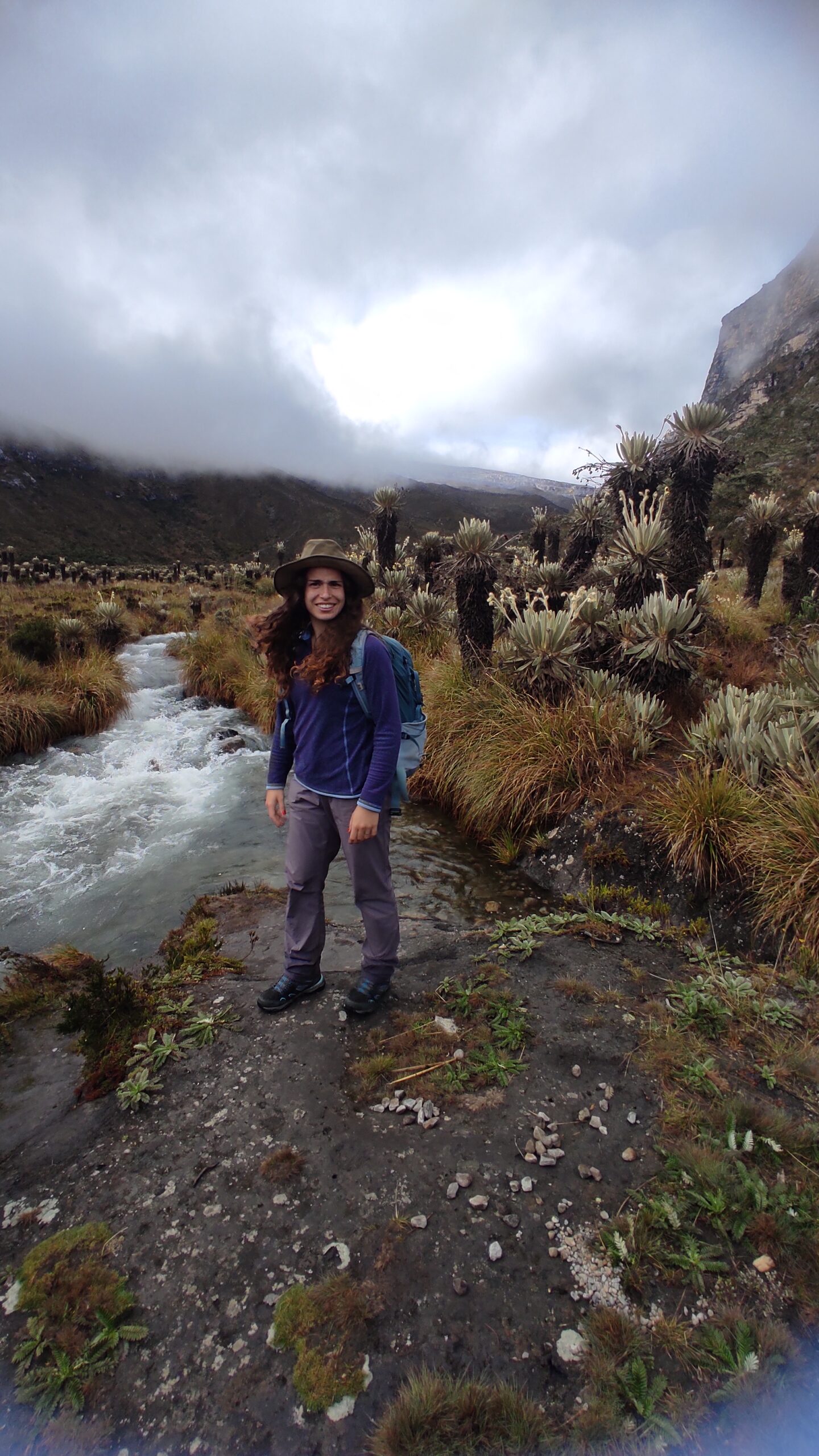
I look back, over my shoulder, my eyes drifting up hundreds of meters through small curbs of the mountain as it twists and turns, reserving its secrets only for those brave enough to summit its 4,600m. The wide paramo is stretching all around me, a vastness of frailejones, low bushes and other native species of Colombia. The earthy colours are teasing my eyes, ochre mixed with deep orange-brown, sage green and light grey. All around me, vast mountains of more than 4,500m impose themselves with natural grace. Scanning the mountain bend I have just come through for my group, I realise that they must be way behind.
The guide must have felt my pain – arising from constantly stopping and starting – and he felt confident to let me go ahead. My phone battery died before we even got to the middle and, although I knew that electronics don’t go well with the cold, I was surprised with how quickly it died (note to self that five-and-a-half-year-old phones probably don’t like mountains that much). So I walk and I walk, without a sense of time, only the accumulating feeling of tiredness in my legs, smoothly making my way through valleys, rivers and magnificent rock formations that are accompanying me in this journey.

[12 hours earlier]
A gentle vibration is coming from the bed next to mine, as one by one the alarms in our dormitory are going off. I tap my phone screen to wake up, reading the time on it. 2:30am. I I murmur a few words, expressing gratefulness to the world and wishing ahead for a beautiful day, full of mental and physical strength. Going up 4,600m above sea level is serious business, and I aim to give it the seriousness it deserves. Rubbing sleep off my eyes and saying goodbye to the warmth of the four blankets that cover me, I start getting ready for the day, with excitement and curiosity filling my spirit.
We are preparing to go up Laguna Grande in Parque Nacional Natural El Cocuy, one of the 59 national natural parks in Colombia. Traversing through kilometers of ‘paramo’, the unique high-altitude tropical ecosystem found in the Andes Mountains of South America, we are mere guests to this force of nature, which is meticulously taken care of by the Colombian park authorities.
Getting into the small minibuses, I take in the sleeping village around me. El Cocuy sits at about 2,700m above sea level, lodged in a small valley in the mountains and organised in a near-perfect grid system of ‘cuadras’, making orientation around it very easy. The houses are white, with matching sage sections, a symbol of the conservative nature that the village first occupied when it was founded in the 1,400s. One of the oldest founded places in Colombia, it combines elements of colonial, republican and modern architecture, with small balconies spanning the corners of houses, or individual balconies just outside of each window. Through the spine of the village runs Calle Real, the main commercial road for many centuries, now overtaken by its parallel Calle Principal. Having taken me about eight hours through winding roads by the side of the mountain to come to El Cocuy, I can’t shake the feeling that we are so far away from most things, tucked away in the serenity of the mountains.

The ‘camioneta’ kicks off, jungling through rough-terrain roads and interminable curbs of the mountain, climbing higher and higher. Dawn hasn’t broken yet, and the sky is still coloured a light violet, with neblinas engulfing us, offering an air of mystique to the already beautiful aura of the mountain. As we start getting closer to the boundary of the park, we are being approached by a pair of security officials, registering our names and welcoming us through to the park. As the sun is peeking in between the clouds, our bus pulls up outside Hacienda Esperanza, a traditional lodge in the mountains. At about 3,600m above sea level, the owner of the hacienda is stood outside, wrapped in a woolen u’wa, welcoming us in, selling steaming hot tinto off plastic cups. I love how much Colombians love coffee, and how tinto is found in pretty much every corner. A group of men, all wrapped in u’was, stood around him, and I soon come to realise that some of them will be our guides. The national park requires a maximum of 5 people per guide, with the mandatory rule that, if any one is required to evacuate the mountain due to altitude sickness, the whole team will need to make its way down. Yet the agency with which we’re climbing have supplied our team of 10 with three guides, to make sure that we can get to the summit, even if a few of us will need to evacuate. It’s a scary thought, yet in high altitudes, one needs to be prepared.
We’re gathered for a short briefing; all our guides are local to this zone and have summited Laguna Grande more times than they can count. This has given them one significant advantage: their bodies are sufficiently acclimatised to the high altitude conditions, capable of managing with a limited supply of oxygen. All dressed in wellies, u’was and rough clothes, I can’t help but look up to them with admiration and excitement for what’s waiting for us ahead.

The night has now given way to the day, and we are setting off. In front of me a few hikers and our guide at the front, as we are making our way through high-altitude fields, with exotic flowers, chunky cows and brown sheep scurrying away ahead of us. The sun is trying to break out from the clouds but to no avail, so I am still in my impermeable jacket, slowly feeling the heat on my body as we make our way across the field. A few kilometers later, the path takes a right turn up through the forest. It’s a relatively simple path, with slightly muddy but overall firm ground interspersed with rocks smoothed out with the passage of time. Turn after turn, we reach a high point and we stop to wait for the rest of our group. To the left of us, four of the twelve peaks of the national park are glistening in the light sun, their brown tips covered with thousand-year-old glaciers. I can hear the birds, the crashing sound of the cascading rivers in the valley to our left, and the panting of my co-hikers. Up ahead in the background, ‘El Pulpito’, one of the most famous and oldest formations of the park is reaching up towards the sky, a brownish-grey rock squared out by the elements, on an inclined altiplano. Yet the most impressive is the view ahead of me: the Valley of Frailejones, the first view of the paramo stretching for about a kilometer up to the next fold of the mountain.
I had never heard the word ‘paramo’ before, and I was amazed to find out that it is a native ecosystem playing a critical role to the water cycle in the area. Consisting of thousands of frailejones, the endemic plant effectively creating the paramo, it’s a zone found below the ‘nieve’, the permanent glacial snowline that covers the tips of the Cordillera, and above the lush forest encountered up to about 3,000m. Its beauty does not just come from its diversity and richness, but from the fact that these special plants absorb the water falling from the sky, filter it, and then slowly release it downstream to form hundreds of rivers. For this very reason, access to the national parks is highly controlled and moderated by the local authorities, aiming to maintain its pristine gifts to life.

We stop briefly by the side of a stream to re-fill our bottles, surrounded by thousands of frailejones and other native plants. Frailejones only grow about 1cm a year, making the tallest of them around us over 500 year-old! There’s a unique sense of peace in the valley, a perfect co-existence among plants, animals and earth. A perfect, yet delicate, balance of nature, one that brings up a sense of responsibility within me to preserve this magical place, but also a very special feeling of completeness and beauty. Filled with awe, we are cutting across through the valley, the deafening sound of the river to our north calming the thoughts in our busy minds. Even at 4,000m, the mind goes on unstoppable, analysing, thinking, reflecting, seemingly immune to the thinning oxygen. This is one thing I love about trekking in the mountains; the walking tends to have a calming effect on my mind, synchronising it with the vibrations of the nature around me, and the energy of life itself as it radiates through the flora and fauna.
The altitude starts to make its presence known in our team, with one of us already succumbing to its effects and starting to make their way back down to lower altitudes. I’m constantly eating: nuts, dried fruit, an apple, not letting my body go into a state of hunger, and constantly sipping water. These are the lessons from my running training in action; when you can feel the hunger or thirst, it’s too late. Dehydration can be proven especially dangerous when combined with high altitude, with the one exacerbating the effects of the other. We are making frequent stops, waiting for the rest of us to catch-up. We keep climbing higher and higher, making our way through the paramo, and soon after entering into super-paramo, the area which used to be covered by glaciers and now sometimes covered in snow. A collection of rocks hastily put on top of each other, my mind is filled with marvel at the magnificent forces of nature, whose collisions were powerful enough to push the earth up 4,600m. The temperature has now visibly dropped, with the drizzle getting stronger and each one of us rushing to protect themselves against the rain.

Shallow lakes make their appearance all around us, a gorgeous crystal turquoise amidst the bland greyness of the rocks. It seems that there is a natural limit after which life cannot sustain itself. Only flimsy moss, coloured deep red and green appear in between the cracks of the roads, with an occasional bird coming by, having accomplished the seemingly impossible task of surviving at such high altitudes. We are around the clouds now, every step getting us nearer to the summit. The air is chilly, a reminder from the earth that we are now mere guests, as much as we as humans often seem to believe the contrary. Up here, the air is thin and our supremacy even thinner. We are but a dot in a fragile ecosystem, perfectly co-existing in the intricate fabric of life, symbiotically counting the passage of time. As we reach up at the Laguna, I can feel the cold air penetrating my lungs, a refreshing crispiness that makes me want to keep climbing higher and higher. We have reached the border of the glacier, and we are running out of time. The parks are strict regarding the time we must start descending and, after a cold lunch in the piercing wind and increasing rain, we start making our way back down to lower altitudes.
