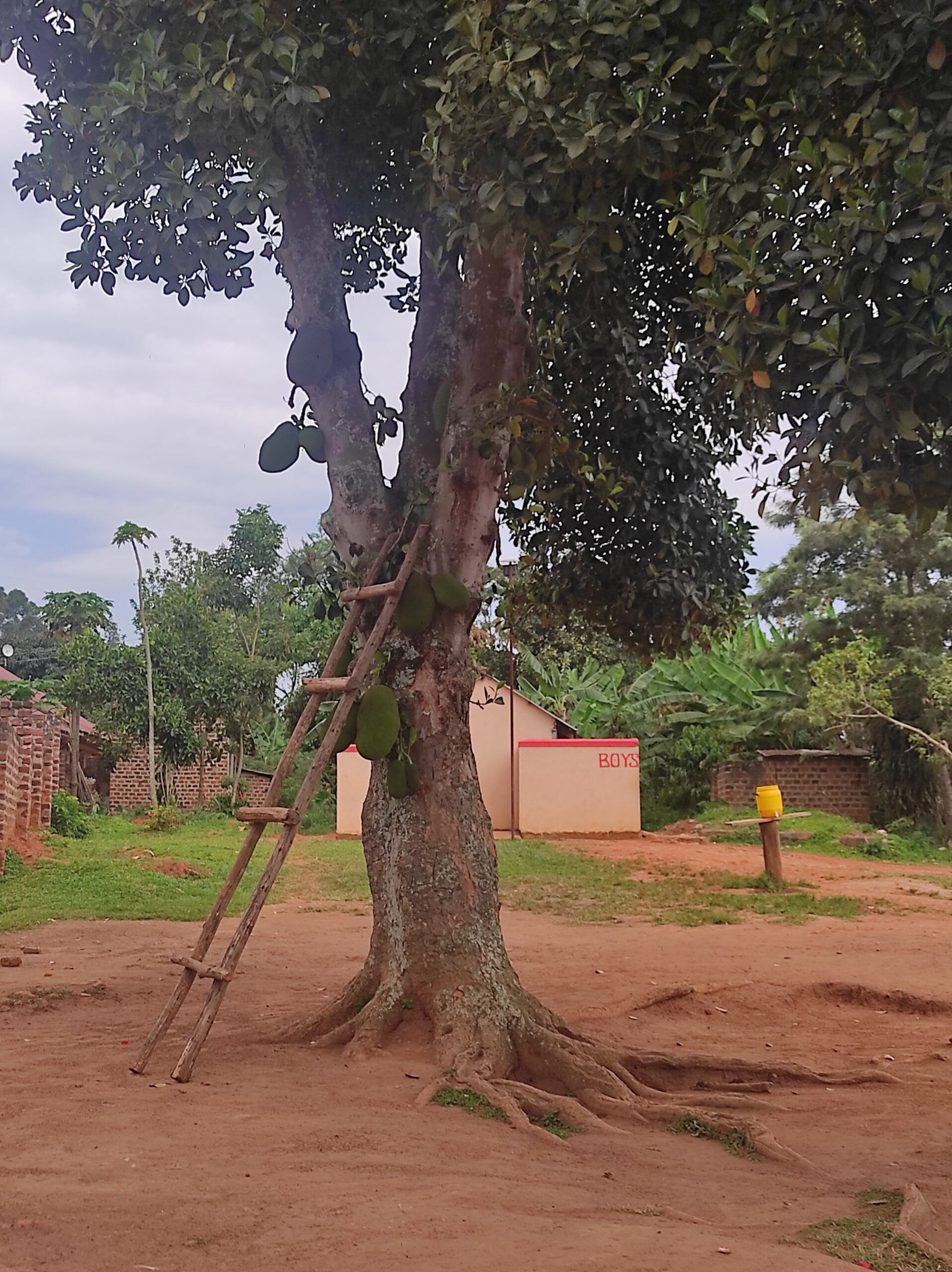
It’s just after 9am on an – already – hot morning. I am writing this sitting under a jackfruit tree, barefoot in the dry African soil, and surrounded by a group of excited young girls aged between 10 and 12, who have taken to singing beautiful traditional Ugandan songs. I playfully glance up at them, only to see big smiles on their faces, a mixture of curiosity, happiness and mischief. In the background, I can hear the soft flapping of geese feet as they make their way across the school ground, and smell the dry firewood burning in the stove. My heart is full of love and appreciation, and the moment bears a rare completeness.
…
After a 14.5h journey from Kigali (my longest bus journey so far!), stepping into Uganda came with a sense of curiosity and desire to explore. The next few months feel exciting, yet nothing could prepare me for the hospitality and love I received right from the start by my hosts from Mothers of Good Hope Uganda, the organisation I will be staying with over the next month or so.

St Paul Kindergarten & Primary School
The first place that has welcomed me with open hearts and minds is a very special school. I cannot describe how fortunate I feel for having stepped into St Paul Primary School in Mbalala, just on the outskirts of Kampala, the capital of Uganda. It’s a true privilege and honour to be hosted by such incredible people within the school complex; a school that functions both as a border school, hosting about 50 students, and a day school, educating a total of 250 students.

All of the students (ages between 5-13) speak and understand English which makes this experience all the more special for being able to communicate and share beautiful moments with them, thanks to the initiative of the very special, progressive and loving woman who runs this school, Sylvia.
It was mostly through luck that I discovered this school, something that made me reinforce my belief that sometimes good things happen when taking a leap of faith into different directions. Finding myself being part of the reality of a boarding primary school in Uganda is unquestionably one of them. Fortunately, I am here during the last week of the term before the school holidays, so the preparations for the graduation ceremony at the end of the week are currently in full swing (I have even somehow gained the privilege of being made the “guest of honour” for the ceremony!).

The school radiates love, commitment to a quality education and respect towards each other. I have rarely felt these incredibly powerful feelings expressed so quickly from a place, but this school really captures your heart within the first few hours you set foot on it. Experiencing a true example of hospitality, it is evident that guests have a special place in Ugandan society, and I have been incredibly impressed with the hospitality of Ugandan people, their respect and appreciation.

The Stories
One of the advantages of staying in a school, apart from that it’s a one of a kind experience, is that I can see the inside of the community life and also understand and appreciate more hidden aspects of African life. One thing I have been realising over the last few weeks is that some African families can be conventional in many ways. For example, the belief that girls are not particularly worthy of being put through education can still be prevalent in many cases. Feeling deeply sad, confused and demoralised (and guilty for the privileges and opportunities I have had), I am eager to understand those troubling intricacies woven in many African societies. Recently, I am starting to understand that dowry is often very real among families of people getting married. What is even more surprising is that, sometimes, poorer families might prefer marrying off their young girls (and by young I am referring to even 14 or 15 years old) to be able to support the rest of their family, rather than attempt to support the girl’s schooling.

Something that touched me since the first time I visited East Africa was that all girls aged about 9 and over, are entirely capable of running a household by themselves: cooking, cleaning, fetching water (in 20lt jerry cans sometimes from wells 500m away from their houses), taking care of animals and, of course, taking care of the younger kids of the house (definitely better than I can, and about 10 years before me…). Many of them tell me that this is necessary for them to be able to find a husband. Already at such a young age many of them are taught the importance of being able to manage a household, and how this will affect their marriage prospects.

Cooking is an essential part of a woman’s role in some African societies.
It’s difficult to describe the multitude of emotions I am experiencing whilst hearing many of the children’s stories. Shocked, frustrated and disappointed at how limiting some traditional beliefs can be for someone’s future, and simultaneously impressed by the resilience, hope and determination I am seeing. The support of the community is heartwarming, and gives me a lot of hope about the so many cases in which I feel hopeless.

The story which affected me the deepest was that of an 11 year old girl, with whom I ended up being very close with, almost feeling like a spiritual sister. Abandoned by her mother when she was a baby, father unknown. Living with grandmother, often experiencing abuse, socially withdrawn and emotionally traumatised. She escaped from her grandma’s house and found refuge as a boarder in the school, currently living in the school and awaiting a legal battle to allow her to not return to an abusive and traumatising environment. However, even if she is supported by the primary school in order to be allowed to finish (currently in year 4), the school is worried that there will be no sponsorship support for her to attend secondary school, which is the main solid form of education many Ugandans never have the opportunity to attend. She is impressively mature for her age, intelligent, hard-working and kind hearted. The school has really been struggling to find sponsorships, with many staff undertaking extra volunteering duties to be able to manage.
If you or someone you know are interested in supporting a child through their primary and secondary education, please let me know and I will connect you with St Paul, as I will be attempting to support them in any way I can. After all the love I have experienced while being here, it is the least I could do.