‘From me too!’, the younger boy cried out as he frantically moved the wooden roll wrapped in about fifty different handmade bracelets in the space between us. He couldn’t have been more than six or seven, his head just about reaching my waist, his haircut of choice the fashionable mullet. His friend, a few years older and with an equally elaborate selection of colourful bracelets across his roll, murmured something to him in Wayuuni. I didn’t need to know what it was; his face had a cheeky expression along the lines of ‘I got here first’.
And the truth is, he had got to me first, about an hour earlier. As I was lifting myself up to enter the camioneta we were travelling in, he looked keen to talk to me, so I promised I would spend time with him when we returned. Hanging about in the area, he must have figured out the patterns of the Jeeps travelling up and down the peninsula of La Guajira, knowing where to seize the opportunity to engage with the travellers. Indeed, he showed up a few minutes after our camioneta pulled up in the same spot a few hours later, his hands full of bracelets, woollen bags and huge seashells from the village of Cabo de La Vela.

Breiner, the older of my two young friends, belongs to the Wayuu community. Their territory spreads along the Guajira peninsula, the northernmost area of South America, mostly comprising what is now modern Colombia and touching upon Venezuela. Like many other indigenous communities, the Wayuu speak their own language and have their own traditions and lifestyle, unavoidably influenced by the influx of technology and tourism. Some maintain both Colombian and Venezuelan nationality, and are relatively autonomous in their community organisation, educational system and environmental management. Yet, what sets them apart from the rest of the indigenous populations is that they were the only group in Colombia who never got colonised by the Spanish conquistadores.
‘They stole horses and arms from the Spanish, and soon enough they were able to put up fights and defend themselves’, our guide explains in rapid ‘costeno’ Spanish, stretching my auditory processing abilities more than ever, as we transverse through the arid landscape of La Guajira. A colour of ochre, with hues of orange, red and yellow, spreads all around us, ‘el desierto’ having dominated this peninsula for millenia. My eyes momentarily latch onto the white dunes in the distance, piles of salt extracted from the numerous salt planes of the area.
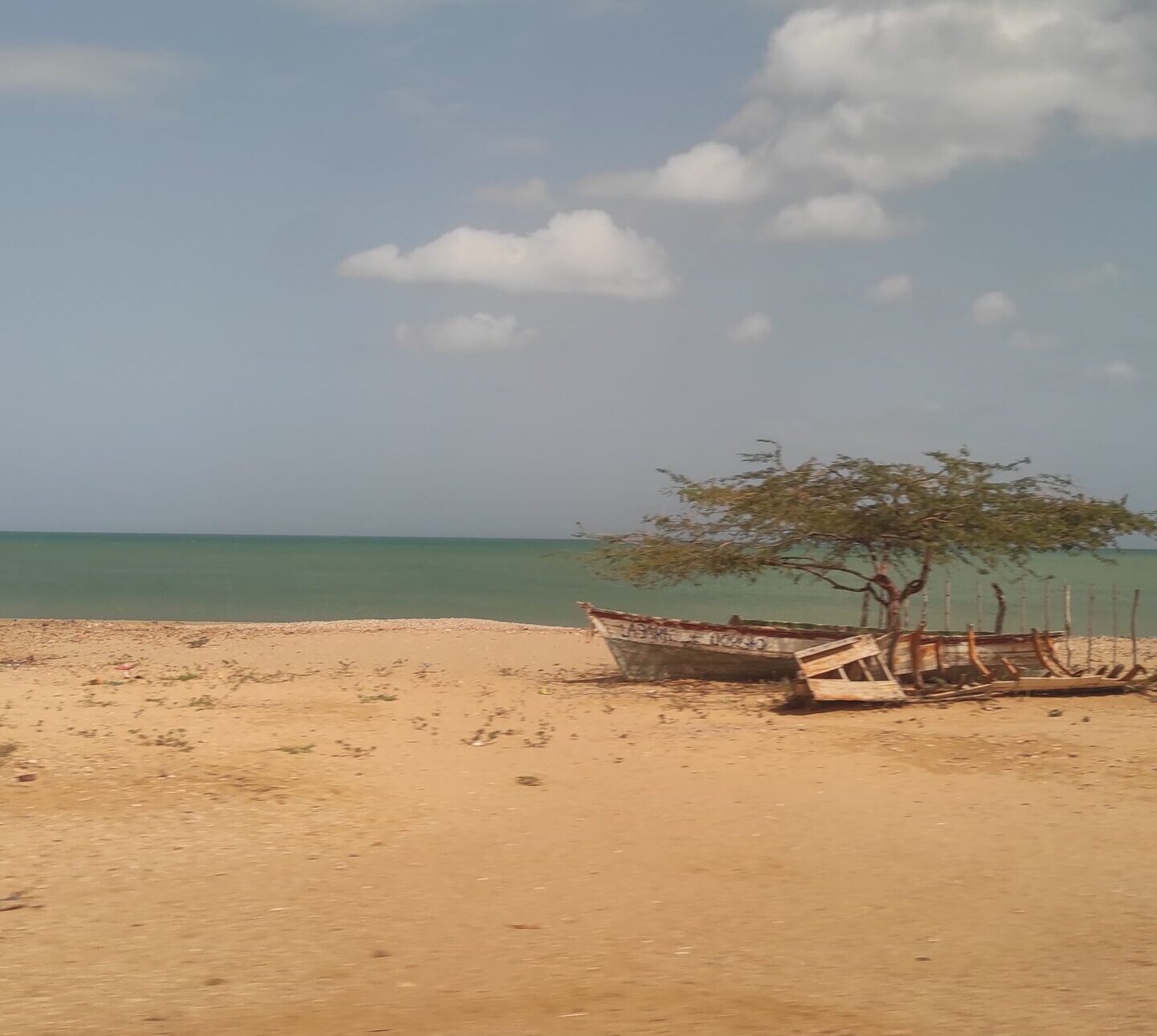
‘They were intelligent, but of course, the Spanish could not have tolerated these conditions…’ he goes on, a hint of satisfaction dancing around in his tone. A quick glance around us suffices to confirm that. To our east, dried-out earth fragmented in typical desert chunks dotted with acacias, cactuses and a thousand different types of rocks. A few goats debating whether or not to cross the sandy path that functions as a road for the brave 4×4 vehicles that tackle it, and a couple of geckos crossing the road with absolute priority. To our east, a spectacular turquoise calm water spreads as far as the eye can see, only gently disrupted by the strong wind that has picked up around us.

As I’m processing the shocking realisation that out of the numerous indigenous groups in coastal Colombia, only one managed to remain uncolonised, a pink and black bird cuts across the blue sky ahead of us, its long wings spread either end of its curvy body, its white beak comically protruding. I’ve seen flamingos before, but never a flamingo spontaneously flying over the desert, and I am stunned by its sheer beauty and unique presence in the otherwise dry landscape. Deserts don’t have the best reputation for diversity, but I am swept off my feet by the diverse details and captivating beauty of La Guajira. Sandy roads that lead into the depths of the desert towards Alta Guajira, wooden shacks interspersed along the side of the road, and Wayuu women with breezy, colourful, long dresses. Their colours seem to vary from red and blue, to pink and turquoise, contrasting against their black hair and chocolate skin. A few of them have their face covered in a black paste, almost like a beauty mask. The white of their eyes is the only thing that stands out from their symmetrical faces, along with the long, coral necklaces they bear around their necks.
‘Natural sun protection,’ I soon found out from our guide, ‘who they make themselves. They take the leaves, scratch them out to extract the pigmented substance, his hands acting out his explanation, ‘and put it on for protection’. I only saw the women wearing it, neither men or children.
As I was hungrily observing every inch of my environment, I tried to carve into my memory the details of the wooden huts of the Wayuu, each paired with a hammock tied between the tree branches that acted as a wooden column of the veranda. Among the children with the colourful dresses extending their hands as the camioneta was rushing past them – fishing for sweet treats – the gentle sand dunes rolling in the distance, and the thin shade formed by the wide acacias, the desert emitted an unbespoken tranquillity. There was a sense of a serenity in the village, a calming aura that accessed a place deep within my heart, activating a sense of balance and vitality, seemingly in contrast with the aridness of the landscape. The young boys next to me seemed in perfect harmony with their environment, their skin barely breaking a sweat.
‘There you go’, I suddenly knelt down by their side and undid the bracelet I had bought from the Mamo, the spiritual leader of the Kogi community in the Sierra Nevada de Sara Marta. It was a simple line of thin black thread with four beads, one yellow representing the moon and three white ones representing the sun. It was meant to be for protection and I had already decided, as we were driving across the sandy roads in media Guajira earlier on, that I would give it to one of the younger boys. I also got out another bracelet, one of those that travel from wrist to wrist in a nomadic fashion, which was also time to leave behind.
So I wrapped the protection bracelet around the wrist of the older boy and the nomadic bracelet around the wrist of the younger one, only to burst out laughing at how big it was for his skinny wrist. They both glanced at each other smiling, their faces shining from excitement and curiosity, along with a hint of uncomfortability at not being entirely sure how to react to my gift. Laughingly, I indicated at them to change bracelets and, after a moment of hesitation on their end, I gently held the younger boy’s wrist in my hands, removed the baggy bracelet and looped it round the older boy’s right hand, while untying the Mamo’s bracelet and handing it over to the younger one. Our conversation had reached the natural end that one reaches when conversing with young children, accompanied – on my side – by a mental search on how else I could engage them, and contrarily – on their side, a casual shift of searching for something else to occupy their mind.

Two laughing young girls started approaching us from across the road, as if brought along by the wave of hot air that blew right over us. A sense of harmony engulfed them like their long, airy, blue dresses. They were slender but not lanky, their attitude reflecting the gentle transformation from a girl’s body to that of a woman, yet maintaining that playful happiness that often gets lost somewhere along the path to adulthood. They were in flip-flops, their toe nails painted a bright colour, their black hair hastily put back in a carefree ponytail, with intricate necklaces around their necks.
‘How old are you?’ the girl asked me curiously, swinging her right flip-flop back and forth with the tips of her toes, her eyes glittering with the unique adolescent curiosity of a 16 year old, who’s aware that they are not quite an adult but are way beyond the childish phase.
‘Twenty-four’, I replied with a smile, suddenly feeling a bit self conscious, to be received by a cheeky smile and a nod from Maria-Angela’s side. I wondered how they perceive a foreign woman of 24 years old, and tried to go down memory lane and remember how I used to think of 20-somethings when I was that age.

The sun was scorching, its reflection off the white sand and the orange terrain that surrounded us making it feel even stronger, straining my eyes and painting my forearms a bright pink colour. My attention kept getting caught by the impressive jumps of the kite-surfers ahead of me, twisting and turning in the air, as if defying not only gravity, but the rules of human reflexes as well, able to grab their board in the air and smoothly mount themselves on it at ten metres over the surface of the sea. Maria Angela was not particularly interested in the surfers – she must have, after all, seen them about a thousand times from the spot where she works.
‘Where are you from?’, the next question came. She was smiling as she was slowly trying to decipher me, as much as I was trying to decipher her. I was so grateful for the opportunity to speak to her, also because I had not brought a swimsuit with me and was not feeling that urge to seek alternatives of getting into the incredibly luring sea right in front of me. I loved how curious she was, not in the usual small-talk curiosity encountered among travellers, often making me feel like going through a typical formality in the likes of ‘hello’ and ‘how are you’. No, Maria Angela was looking forward to my answers and wanted to hear me talk and explain, her eyes a mirror of patience and wisdom that one does not encounter often among teenagers.

With the sun relentless above our heads, I suddenly longed to get back under the shade, but I also wanted to explore the village a bit more. The wooden houses on the sandy beach by the turquoise calm waters, with every corner of cement hidden under colourful graffitis, with the smell of fish and coconut rice wafting across the air, it appealed to all my senses. I asked Maria Angela if she wanted to come with me for a walk across the dusty road, but she moved her head from side to side, as the international gesture of politely declining my offer, and indicated towards the women selling the traditional Wayuu mochillas. Instantly, I understood what she meant.
‘You have to work, right?’ I asked her gently. She nodded emphatically, swinging her leg from side to side to occupy herself during what – I felt – like a slightly awkward moment. Like many places around the world, play or rest for children occupies a distinct place in their lives alongside work, often without any negotiation. I longed to find out if and how that truly affected her. Whether she accepted it and embraced it as an unquestionable part of life, or whether she was aware of how different her lifestyle was compared with many other children across the world.

Yet, there was a certain pride across the Wayuu, a certain appreciation of life and the world as it is, away from the complaining that often inhabits other societies across the world. Having connected and made shared memories with different communities across the world, I have come to realise the concept of relativity on a sociological level. Every community has its own way of looking at the world, its own stereotypes, assumptions and biases. At the same time, aspects of life which we have come to consider as conditions for leading to happiness, are often not shared by other communities across the world. In this internal competition for achieving a state of happiness, the realisation that – provided personal freedom and human integrity are provided – happiness is a personal choice seems more prominent than ever.
Honoured and delighted to have spoken to her, and after rejecting another call to buy a ‘mochilla’, I gave her a loving wave as I made my way across the road lined with 4×4 camionetas and stepped on the hot, glistening sand. The brightness accentuated by the reflection of the sunlight, I walked just across to the water, turned left across the beach and passed a collection of wooden shacks selling fruits, kite-surfing lessons and tinto. No street vendors seemed to be hollering the streets – it was, afterall, the time that the sun had reached its zenith. I managed about 10 minutes, not honouring my Greek-summer and sea-faring heritage, and I was back on the road quickly making my way to the attractive shade of the restaurant. As soon as I stepped underneath its shady canopy, I scanned the space for an empty table, put my sweaty bag on the chair next to me and reached for a cup of tinto from the plastic thermos across me. Taking a sip and savouring its sweetness, I let my mind wander.
The Wayuu might have never been colonized by the Spanish conquistadores, but they certainly managed to inhabit a place in my heart. Their spirited conversations, their hearty laughter and their tranquil mannerisms amidst the arid landscape and the harsh conditions that accompany life in the Guajira, stood out like a genuine oasis in the desert. The blend of sage cactuses and ochre stones, the colourful mochillas of the Wayuu and the spiritual totemic symbols hinted at a simple, connected and harmonious existence, just like the waves gently rolling across the turquoise waters.
