Morning, around seven. The sun hangs very low over the Eastern Region of Uganda, an orange ball of fire. I have filled two 20-litre jerrycans for bathing and flushing, which I have somehow managed to carry for a distance of about ten to fifteen metres. My host Rebecca and I are sitting on the ledge, enjoying a cup of aromatic locally-roasted coffee in the soft morning light. The lush banana plantations are already shimmering, and the sun sprinkles a glittering silver shade over the leaves of the trees.
Beside us, the neighbouring family has already begun working on the fields. It must be a small family, perhaps two or three children, cultivating the plot next to the small house and the grass-thatched huts in which they live in. People here own their land, and on it they build the homes, huts, and farms they need. People in rural areas rarely buy a finished house.
The gentle simmer of matooke can be heard in the background – a traditional Ugandan dish and one of my personal favourites. Green bananas mixed with tomato sauce and punchy curry powder, cooked just right – neither too soft nor too firm. A portion in East Africa is what I’m used to calling a double portion, even for children. This does not surprise me though; people are constantly on the move throughout the day, engaged in physical labour. Food is precious, and when you have it, you eat it! You don’t let it go to waste, because many times you don’t know when the next meal will come, especially here in the rural areas.
In the foresaken villages, most people eat three times a day, with one or two breaks for tea and a quick snack, such as soybeans (delicious) or peanuts. But some eat only twice a day, if they cannot afford breakfast, or even just once – one large meal during the day. I learn that it is quite common to have just one large meal, late in the afternoon at around four or five. Other times it depends on the season; during the dry season, when many crops are limited, many families can manage only two meals a day. I can’t stop wondering how children are supposed to concentrate at school the next day…

Today is Saturday, though I keep losing track of the days. Every day I am doing some kind of work, and ideally I write a lot, so the strict sense of weekends has faded into a creative blend of productive work and exploration each day. Writing and travel journalism do not feel like work to me; they have given me a unique lense through which to experience this multilayered journey. Socialising and spending time in nature are woven into my daily life, striking a balance that is a rare occurence for me. Today we have a meeting for a possible future project of the charity organisation in which I’m being hosted. Arrival time is between eight and eleven, with the meeting set to begin at eleven -African time, of course, which implies great flexibility. And how could it not, when public transport schedules are always approximate. Often, before you go to a ‘stop’ it’s impossible to know how long the bus will be or how long your journey will be in total; ‘stop’ in quotation marks, because mini-buses (called ‘taxis’ or ‘matatus’) often stop wherever they see passengers waiting by the side of the road. They do pass frequently though, and drivers press on to get there as quickly as possible, sometimes in dangerous ways.

We prepare for the guests’ arrival. Have you ever sorted rice by hand? It is an art. Like searching for a needle in a haystack. Tiny pebbles, white or beige, exactly the same colour as the rice grains themselves. A large platter of rice is staring me in the face from the bamboo mattress in front of me, and a huge sack to sort through is patiently waiting beside me. The technique: I put small quantities of rice at a time on the platter and slowly flip it a few times, so I can spot the pebbles and twigs among the grains. Fortunately, whatever remains will be small. My (attempt at the task of) sorting the rice is accompanied by a few snacks, served by the young girls chatting around me, mostly crunchy and wonderfully sweet peanuts. Children are used to helping extensively with household tasks, in ways that often unsettle me.
“Shall I give more?” asks Rebecca’s mother, the chairperson of the women’s group I work with.
“No thank you, later,” I reply with a smile, nodding my head and gesturing with my hand to indicate the passage of time. I had breakfast not long ago, but they ate three or four hours earlier – or some perhaps not at all. Another snack that I’m offered: soybeans. So flavourful; I am impressed. They give me a full plate of seeds – just for me – and I nibble distractedly while trying my best to focus on the interminable heaps of rice.

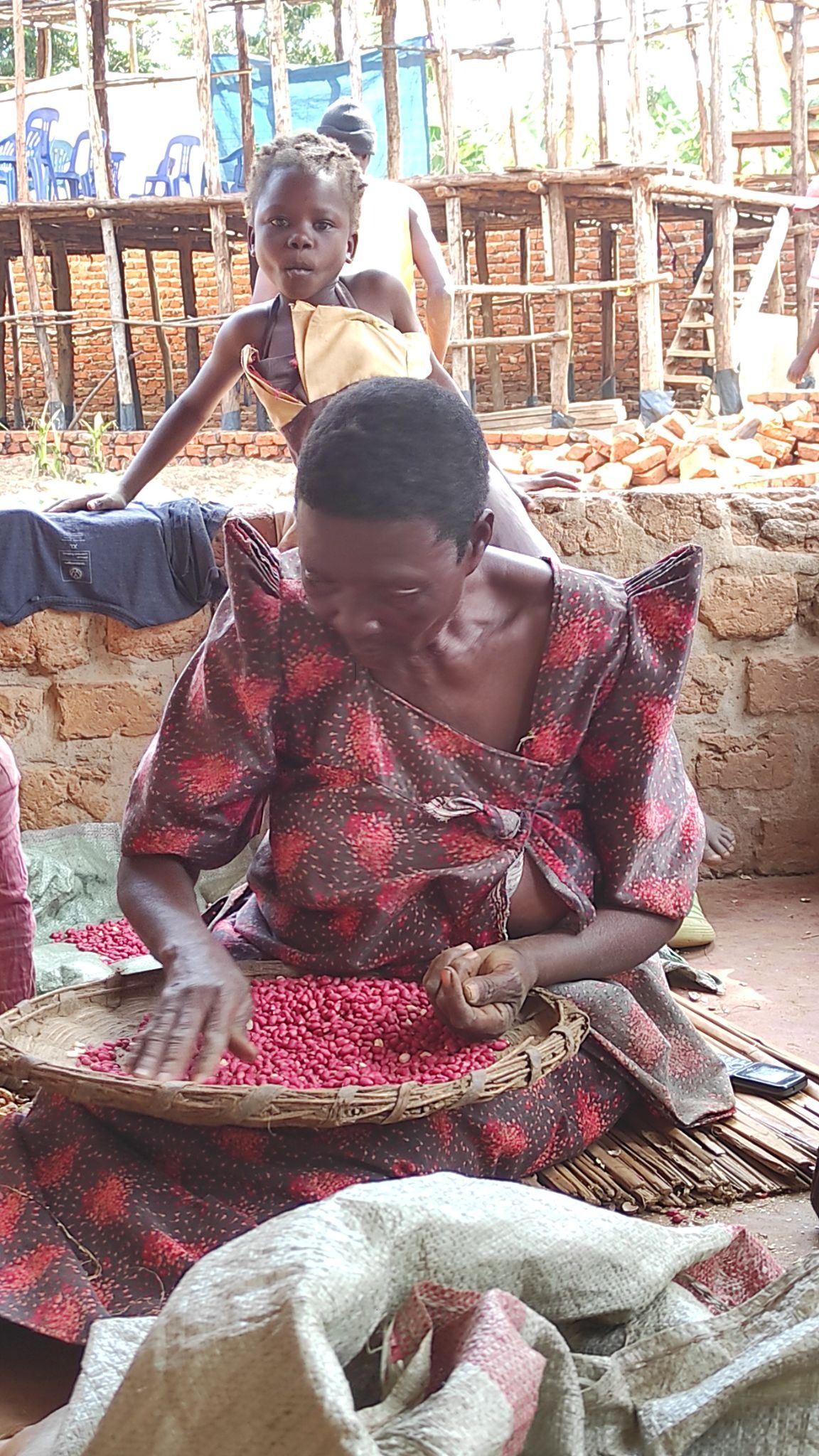
Next task is peeling peanuts. One woman and a crowd of children sitting directly on the ground, on handmade bamboo mats. These mats are, for many people, also their beds.

Crushing the peanut shells come more easily to me than sorting through the rice, perhaps because I’ve done it before. These are called ground nuts, and they are a delicious combination of fresh crunchiness and rich sweetness. During events like this, and especially when guests are expected, such tasks are carried out by the women of the community. The responsibilities rotate among the members of the community like a carousel; since there are many eager mouths to feed and many calloused hands to help. Right now there are around twenty children around me and certainly about ten women. The rhythmic sound of an axe echoes in the background. The men are cutting wood for cooking. The pots are large – cauldrons, really – balanced on four or five large stones with fire burning between them. Hot smoke fills the lungs, day in and day out, at every meal. Anyone who arrives will eat and drink tea as generously as possible, treated with far-reaching respect. There is deep appreciation for someone who has made the effort to travel, and this is met with great respect.

Shortly after eleven, people begin to arrive. It is twelve and the meeting has still not begun. I sit on the bamboo mat and try to write, amid conversations with children and their shy laughter. Suddenly, a bicycle stops beside me. The cyclist dismounts, soaked in sweat. Four 20-litre water jerry cans filled with water from the well are fastened to the bike. Barefoot, wearing a stained red long-sleeved shirt with holes front and back. Loose dark jeans (black, or perhaps blue), torn at the edges. After unloading the jerrycans beside me, he sits to rest under the lush mango tree.
I feel a sense of shame. I sit relaxed, writing in the shade, drinking sweet green tea made from local herbs, while the man – no older than forty or maybe thirty-five – has worked himself to exhaustion to deliver us water. For them, this is simply life, and for him, this is his job. This is how he earns a living, delivering water to people around the village. They are accustomed to it from childhood, just as we are accustomed to turning on a tap to drink a glass of water.

At the edge of the banana farm, a group of children sit eating jackfruit, their favourite snack, though I cannot say it is mine. It looks somewhat like a watermelon on the outside and tastes like a sticky melon, in a completely different shape, made up of many small segments tightly pressed together.

One hand holds the fruit loosely while the other separates the segments, as we would with an orange. Chrats, chrats – the sound of children enjoying the sweet, refreshing fruit in the shade of the matoke trees. The temperature is around 27 degrees now, and the children are amazed that I can tolerate – and even choose – to sit in the sun whenever I find the chance. The fact that they are eating jackfruit is not particularly surprising to me, but what they were doing earlier is. About ten minutes before, they were plucking chickens that had just been slaughtered for our lunch (I am certain these were the same chickens I saw freely roaming the yard that morning!). Suddently, I watch the children drop their knives and run to the woman calling them to eat fruit.

I notice a small blue basin, where they may have washed – or rinsed – their hands before eating the fruit. I imagine the reaction of a seeing their child handling raw chicken and, ten minutes later eating fruit with their bare hands. Yet this is life here. Babies sit naked on bamboo mats, many without nappies. I learn that nappies are rarely used because they are expensive, and instead babies are trained from a very young age to signal when they need to use the toilet (I don’t think we have this kind of training in the west!)

Enjoying – or at least trying to enjoy! – a piece of boiled cassava, one of Uganda’s local vegetables.
I get distracted by the crowd that, after two hours past the scheduled time of the meeting, continues to arrive.
My thoughts are running in different directions, sprawled like the bright green rice plantations all around me.
I keep reflecting on everything I have been observing whilst living in the small, foresaken village of Kameruka in the eastern province of Uganda.
Life is inherently different, but people’s desires are fundamentally the same. Everyone wants to be happy, healthy, provide and secure a bright future for their families.
In the end, how many different ways are there to do something? Which is right and which is wrong – and why does our society teach us that one way always has to be better than another, especially when both achieve their purpose without harming anyone or anything?
