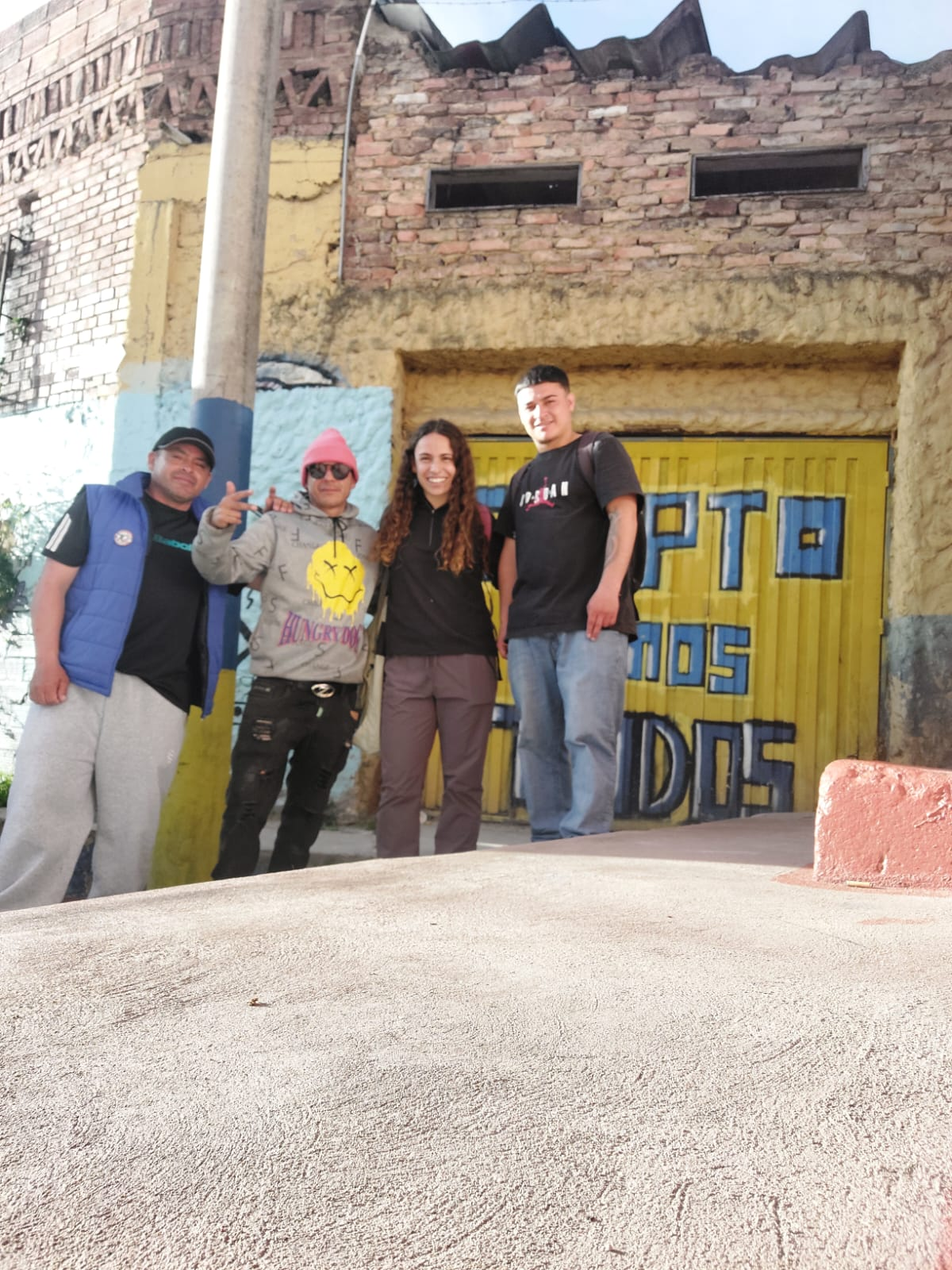
‘I was standing just here, with my 3 brothers by my side,’ Monkey pointed by the side of the orange door of the green house by which we were stood.
‘Drinking, smoking, marijuana, you know…’, he laughed and looked at me cheekily whilst imitating a smoking gesture with his calloused fingers.
‘And then…’ he paused, momentarily transported in a very different reality in the same barrio, ‘four guys from the other banda came and…boom, boom, boom…’ he trailed off. He acted out the scene with cinematographic accuracy and I could almost hear the sound of the shotgun that his ‘enemigos’ fired.
‘I was the only one who survived…’ Monkey, as Jose is better known in the barrio, seemed different than I expected. His tone was chilling, but also incredibly natural, as if this was something that, sooner or later, they expected to come.
Monkey rolled up his ripped black jeans to show me a spot above his knee, where he had been hit.
‘The first bullet got me here’, he then pointed on his upper thigh, ‘but I was really lucky it only got meat and not bone, and I could run…’.

The sun shone through the dispersed clouds that descended Cerro Monseratte, the mountain that lines the east side of Bogota, as if in an allegory to the transformation that had taken place in the favella.
Riddled by gang violence, Barrio Egipto has been one of the most underprivileged areas in Bogota, the capital of Colombia, and it has carved the lives of many people. Yet, the decency with which he was describing a horrid – but typical – scene of the 90s in the neighborhood, exacerbated my impression that, at the time, scenes like that unfolded on a daily basis, stigmatizing the collective psyche of hundreds of people.
Andres, the creator of ‘Breaking Borders’, approached us from underneath a corrugated metal canopy. His aura radiated a warmth that I very rarely encounter in people, one that leaves you with the impression that there is a lot more to him than what meets the eye. I had only met him a few hours earlier, when I reached out to him to enquire about visiting the Barrio, and he offered to take me out on a tour.
‘Rompiendo Borders es una transformation humana, que habla de amor y de felicidad’, he smiled at me through squinting eyes in the now blaring sun of the afternoon. We were stood on an uphill, as the barrio lies by the side of the mountain. The walls of the houses around us are decorated with a variety of graffitis, all showcasing the vibrancy of Colombian culture, and narrating the story of the barrio in their own unique way.

‘This one is from a Mexican artist,’ Andres pointed towards a beautiful mural of a woman. Her hair was long and pulled back into a ponytail, and her eyes gently closed. I could make out the characteristics of an indigenous Colombian, perhaps a ‘muisca’ from Bogota. Her back was gently turned on us, and she was holding a colourful flower in her slender hands.
He continued with a deep sense of melancholy in his voice.
‘It’s for all the women of the barrio, all those who lost their children, who couldn’t sleep at night. There’s a lot of pain in the barrio, and this graffiti is in honour of them’.
Engulfed in a sense of unbeknown sadness, I tried to put myself for a moment in the position of a young woman growing up in the barrio in the 80s and 90s. Every corner was lined with children playing football, seemingly innocent. Yet, as I was about to learn, this plausible everyday scene hid beneath it an obscure and dangerous reality.
‘The ‘cabanario’ over here’, Andres continued, turning back towards the entrance of the barrio ‘was an important position’.
It’s an thick pole with red, blue and green stripes lining its bottom side.
‘We were playing football right here in this crossroads, but…we were watching, invigilating everything that was going on and everyone that was coming through’ Andres explained, with an almost cheeky tone in his voice. Every movement was tracked in the barrio, and no one would pass through without the children identifying their next steps. For an old one, they would touch their hair on the left side, and that meant: ‘quedemos tranquilo’. We stay put, no action.
‘For the police’, Monkey chuckled next to us, ‘we had our own secret escape routes… We would run across the dead end over here, and jump over the white-washed building… they would lose us, and we were safe, within our territory, of course’. There were four different bandas controlling Barrio Egipto, and we were stood in the territorio that Andres and Monkey grew up.
‘Up to the border, we were safe, we knew how to move…But…for a traveller like you’, Harold, the third guide in our tour, a 20-something from the barrio, smiled as he acted out scanning me from head to toe, ‘it was this…’ he paused and touched his left shoulder with his right arm, ‘and…we were on you to rob you…’.
A mixture of surprise and shock run through me, as I was trying to imagine a reality so foreign to me. I felt as if reading a book about the history of favelas in Colombia, but rather than imagining it from a distance, I was now looking at three survivors of this reality. Three people whose lives had become inextricably intertwined with the ‘banda’ reality in the barrio. Harold embodied the possibility of transformation and the wind of opportunity which blew over the barrio, thanks to Andres’, Monkeys’ and a few others’ initiative.
‘Now you can sit here, with your phone out, no one will harm you…But there days…’ I wonder, how many memories must be going through Andres’ mind in only a single moment. He seemed to get lost into the abyss of his memory, a mezcla of traumatic experiences interspersed with the desire to make a change and create a bright future.
‘One day,’ he continued, ‘I was about 12, walking down the street, here, just right here’ he pointed to a shop just a couple of meters away from us, ‘a friend of mine was with his girlfriend walking, and someone who was an enemy came and boom, boom…’ I had lost count of the amount of times I heard this, ‘and his friend, took out her pistol and… boom, boom… shot him right in the face…’ Andres paused only to check my buffled frozen expression, ‘that’s how these days were, for all of us.’ A silence spreads among us, the variety of emotions almost visible in the air amidst the few happy voices of the children passing by.

‘We had no fear of death…’, Andres looked at Monkey who nodded at his statement, with the simplicity of someone being asked how was their day, ‘we knew it would happen one day, it was inevitable. We had no fear’, he affirmed again, more so to his past self, than to me and Monkey.
A whirlwind of thoughts was going through my mind at the speed of light, the prominent one being a chilling fear and admiration for the three men in front of me. I struggled to picture that this calm and colourful barrio was once a daily reality of gang violence, guns and abject poverty. The transformation had been incredible, and my heart was full of joy and appreciation.
We made our way up through the streets, as each colourful house gave way to the next. Children were lining the sides of the streets, coming back from school – the school of Fundacion Teyendo Corazones, which runs classes for the children of the barrio.

We came up to a detailed graffiti of an older woman, with a radiant smile and curly silk-grey hair, underneath an overloaded pole of electricity, which stood as a reminder of the reduced health standards and late electrification of the barrio. There was no medical centre in the neighbourhood, and the only one who provided medical care was Celina, the Medellinian woman who’s smiling at me from the rough wall opposite me. Next to her, an older man who had the only telephone in the neighbourhood and every morning, he would call out to people:
‘Ven por el telefono, el telefono’, Monkey shouted with his hands around his mouth, ‘and people would run towards him’. A smile forming across my face, my mind is expanding into different directions, realities which happen around us every single day in many countries. within African villages, I’ve seen poverty dripping all around you, an inescapable type of poverty, like a snake tightening its long tail around you. But this face of Colombia, one riddled with drugs, violence and gangs, has opened my eyes to an alternative reality, one which has made me wonder, one more time, about the privileges of opportunities that some of us have, whereas others have none.

‘There was no school, either work in construction or be in the banda’ Andres continued as we turned right into a smaller side street, whose entire length was covered with a graffiti representing the cultural diversity of Colombia, crafted by an Argentinian artist.
‘I loved looking at the men who worked on construction sites, their clothes all dusty and with stains of paint… But the girls, you know…they didn’t like the construction men, they liked the gangsters. There was no other option, you would either be with them or struggle for food, for money, we didn’t have much.’
‘One day, I saw the jefe sat just here on the side, by the mirador’ he pointed to where the road finished, with an excitement and curiosity that made me realize he was reliving the moment himself, after about 35 years.
‘He was all impressive with big guns, and I admired that, a lot…’Venga chico’ he told me, and of course, I went towards him, not knowing what to do.
‘And…that was it… My inauguration had begun…There and then, in the middle of the street in Barrio Egipto, I learnt how to use a shotgun. But, not the one that we all had… Of course, all the children at the time had guns, hidden underneath our jackets… you wouldn’t go out without one… But this one, it was an escopeta, a powerful pistol which none of the children had. I was now part of the banda, and that meant one thing… I would be able to earn money, for me, and my family.’
Awe encompasses my being, and I let Andres take me with him into a journey in the past, where it all started…

‘My first job was up there in that street, you see that?’ he asked me, while pointing at a small street up in the mountain, almost tucked away by the lush tropical vegetation around it.
One day soon after his initiation, Andres fired out his gun in the road, without really knowing how to aim. What ensued was chaos, with scared pedestrians scattering around the alleys, but also something unexpected. The jefe picked him out; he had shown a strength that enabled him to get a better pistol, one that only the engaged members of the gang had. He was in shock, but he knew this meant he could participate in robberies and gather money for his family.
I am carried away into a day in the 90s, in the small labyrinth-like colourful streets that spread around the barrio, and the sounds of the pistol firing is echoing around my head.
‘We went out on a robbery, and they dressed me with black clothes over my dark grey jumper, for protection… When we came back, the jefe put a stack of money in my hands. ‘That’s for you, he said.’ I didn’t know what to do, I had never held so much money in my hand. I would see the bandajeros driving down with motorcycles, jackets and jewellery and admired them, wanted to have money… We didn’t have any other opportunities apart from learn in the school of the streets, and I had now got into it…’ his voice trailed off…There were so many emotions underneath his dark eyes, and the melancholy and sadness that he radiated made it entirely obvious as to why he had chosen to create Rompiendo Borders. To break the borders between life in the favela, and life in the rich area of La Candelaria, lined with artistic bohemian cafes, galerias and international universities. Andres, Monkey and his friends never have the opportunity to attend a university like this, but perhaps their children would – and it turned out that this motivation alone was the catalyst for change in the barrio.
‘That day in the robbery, I went home and got my brothers with me to go to the market…I got meat, rice, maize, toys for them, everything… Things I’d never held in my hands…My mum came home and saw us…She thought I was working in a store up the road, helping the old man with the produce…She just looked at them and asked me why I had spent so much money on toys…You see, we needed money for the rent…But I got out more money from my pocket and I told her ‘I’ve got more, don’t worry…’, I always dreaded lying to her and was so scared she’d find out I was with the bandas, I didn’t want to hurt her…’. Sadness, guilt, and an intense self-awareness were radiating from his persona.
‘I’ve done bad things, we all have in the barrio…But no more, we now have a future for our children…’ he concluded, as we momentarily stopped in a small square.
Andres proceeded to reveal the numerous scars he had on his legs, torso and shoulders. No one who lived in a favela in these days remained unscathed, and them being there with me stands as a testimony to transformation and change.
I’m left with so many questions; how exactly did that stop, how did they manage to carve out a different path for themselves and their community? I’m left with the desire to learn more about such communities, especially when they manage to transform the future of so many people.
Just right at the end of the street, a wooden door lined with black and white designs hid away Fundacion Teyendo Corazones, another initiative of the barrio. Andres knocked the door and I was welcomed by Carolina and her husband, who showed me around the workshop. It was a beautiful wooden structure, with a large window from side to side letting in plenty of light and gifting a beautiful view of downtown Bogota. A row of weavers stood across me, women in different ages weaving traditional umas, a colourful woollen overcoat for the winter, similar to ponchos.

The sun had come down, a golden texture woven through the reddish bricks of the favela, with the metal corrugated roofs glistening on its reflection. We crossed a wooden handmade bridge over a small river across the other side of the favela. I looked behind my shoulder, line after line of houses crumbling over each other, painting the side of the mountain with colourful hues dominated by red, blue and grey. A scramble of small houses, some of them erected on wooden decks, with rambles and a couple of stray dogs finding refuge from the sun and the (imminent) rain underneath them. A calmness engulfed this side of the favela, and I struggled to imagine how, only some 10 years ago, it was a place of guns firing, desperation and fear.

A small football pitch stood at this side of the building, and address explained to me how it was the latest project of Breaking Borders, aiming to give youth a place for recreation, away from the option to get involved with the gangs.
‘We fight violence with art and sports, focusing on love. It’s not what you can buy, it’s not what I bought that day after the robbery, that’s not happiness. It’s giving the young the option to choose their lives, choose their future…Now this, it’s true happiness and human love.’
