The warm afternoon sun is penetrating through the slits of the homemade kitchen shed walls, its rays like a laser casting a revealing light on the livelihoods of a family nested in a village in the lowlands of northern Malawi. The leaning walls bear a washed grey colour, the bricks hastily plastered with mud, the fresh smell of earth making its way through my nostrils, taking me back to hazy childhood memories. Awkwardly sitting in a roughly-cut log with the sharp marks of the saw tattooed on its sides, radiating the physical strength and mental resilience of the young girl who chopped it, I am eagerly watching the everyday scene unfold in front of me.

Gift, the mother in the family with which I’m staying, is bent over a metal cauldron bearing the signs of the passage of fire, smoothly stirring the mixture of cassava flour and water with a sturdy piece of wood. Her elastic body is bent in the middle like a cracked piece of wood, her arms moving flawlessly around the cauldron that fills the shed with its overpowering presence. She is cooking nsima, a common staple food in Malawi consumed on a daily basis due to its availability and low cost. The family cultivates the cassava itself, as do most of the families in the village, its existence intertwined with its crops like the branches of the avocado trees surrounding the house. Its tangy smell is forever carved in my memory to transport me back to this forsaken place, only an hour on foot from the nearby town, yet so far away at the same time.
I am in Chikombe, in the lowlands of northern Malawi, spending a week volunteering in the local secondary school. The half hour walk through the rolling hills after a long day at the school was all I needed to be eagerly looking forward to a warm plate of nsima and local vegetables for lunch. Accompanied by a company of cheeky smiling and excitedly whispering children, I arrive at the house yard and decide to join Gift while she is preparing lunch. Even though lunch is part of my volunteering exchange, I respect how well the family is trying to take care of me. Accompanying her daily routine of cooking for the family -which is intricately interwoven into the village life like a spider web- feels like the least I can do to show my appreciation.

As I enter the kitchen, she lets her eyes briefly navigate from the cauldron to me, casting a warm smile my way, and then quickly drawing her eyes back to the food shimmering underneath her. She doesn’t speak English, apart from a hesitant ‘hello’ and ‘thank you’, and so, combined with my utter lack of Chichewa, a widely spoken language in Malawi, my opportunity to get to know her properly is nipped in the bud. She is now standing right next to me, yet the gap between us is staring me in the face like a deep rift formed on the surface of the earth.

Most days, her life revolves around taking care of her extended family, a total of 6 adults and 8 children. Drying and grinding cassava, chopping firewood for cooking, washing up and cleaning. Personal time or hobbies are unbeknown in the village, with most people working round the clock to support and provide for their families. Like a well-oiled machine, fueled by resilience and persistence, she keeps going day in and out, without any lofty excuses.

Every time I look at her, I wonder how she perceives me, a woman twenty years younger than her, in a foreign land some 6,000 miles away from home, discovering herself and exploring the world. Her, a mother of 4 children and an aunt to another 4 living in the house next door. Probably tied to this beautifully hilly village for the majority of her life, in the periphery of the volunteers’ busy and self-important lives, always one step away from being plunged into the abyss of poverty, making ends meet in whichever creative way possible. I am trying to engage with her, but her short, transactional manner gives me the impression that she has no founded interest in getting to know me; or maybe she would, but our language barrier has solidly imposed itself in-between us. In her dark black eyes, I am probably one of these mzungu who tap in and out of her family life, willfully offering their expertise and love, and then departing for even more adventures, exciting places and meaningful encounters. I feel a sense of shame engulfing me like a hungry hyena, the sense of privilege unintentionally but unavoidably dripping over me. My decision to join her whilst cooking was another attempt at being immersed a little deeper in her way of life, rather than consistently be on the receiving end of it.
She doesn’t pay much attention to me, and so, after she serves me a huge and delicious place of fresh nsima and boiled spinach, I grab my disappointment by the hand and, armed with the desire to explore the village, I put on my hiking boots, grab a bottle of water to battle the afternoon heat and 99% humidity, and I head out of the smoke-filled yard. Philip, Gift’s husband and the director of the school I’m volunteering in, has told me about the local beach on the shores of Lake Malawi, about an hour hike down the hill through the mud-covered twisted paths dotted with mango trees. It’s hot and stuffy, and the prospect of a refreshing swim seems to already be invigorating me, energising my body to keep pushing through the sticky afternoon.

I follow the windy path outside of the house, leading me across the football pitch -where the hype for the upcoming local match seems to be building up already- and down past the numerous food stalls selling roasted chicken and chips. Windswept wooden shacks withstanding the passage of time day in and day out, with dark faces staring at me through the gaps, an interesting blend of curiosity, hesitation, intrigue and speculation harboured in their eyes.

I walk past small mud huts housing whole families -interrupting herds of cows grazing intently along the street- and pause occasionally to grab some snaps of the lush tropical scenery embracing me. As I’m descending the hill, my mind is running wild in a whirlwind of self-contradicting and deep-reaching thoughts, and the physical space around me translates itself into the mental space that I need to reflect on the concepts of privilege, opportunity and poverty.

Suddenly, I spot a mango right there on the floor in front of me. Its peel an orange with a thousand shades of red, brown and green, it looks like it has just kissed its tree goodbye and gravitated its way to the ground. End of January is rainy season in Malawi, and so the mango trees are brimming with sweet and juicy fruit. I’ve been watching kids sucking them joyfully around me all week, and yet I have not managed to find a good one myself until now.

With a smile of surprise and joy spread across my sweaty face, I bend to pick it up and, engulfed by a sense of mischief, I quickly scan around me, as if to see whether anyone has discovered my secret. Diving into it straight away, I’m cherishing the quality of freely grown ‘organic’ fruit that I’ve been eating over the last few months in Africa, with their deep penetrating sweetness nourishing my body and spirit.
‘Hey, mzungu’ I am startled when I hear a friendly, rusty voice in a thick African accent from one of the houses to my left. I turn in the direction of the voice, squinting my eyes in an effort to spot the face of my unknown caller among the countless trees, their leaves a yellowish bright green in the sunlight, swimming in the humid air and taking me in just like everyone else.

‘You first-e come’ the voice says, this time materialised in a middle aged woman who emerges from the trees with the grace of a butterfly breaking from its cocoon.
With a mouthful of mango and the happy eyes of a child who’s finally been allowed to stuff themselves with a sugary treat, I greet her warmly. My hands sticky with the juice that I’m struggling to contain, yet she insists on giving me the warmest handshake, taking hold of my least dirty hand in both her hands, and greeting me with eyes that radiate love and compassion.
‘Come, I give you better mango’, she says while pointing at the nearly-finished mango I have managed to swallow within a few minutes. I thought my mango was excellent, but I am not going to refuse her mouth-watering offer. I follow her along into the courtyard of her house, a small mud-washed building with a few jerrycans scattered around and a couple of chairs waiting for us. In one of them, a young girl -no more than 14 or 15- is peeling what looks like sweet potatoes in a bright purple basin. My mango guardian calls something at her in Chichewa, and the girl slowly puts aside her basin, never taking her eyes off me for a second, and nonchalantly gets up and disappears within the house. The woman is eagerly waving at me to sit in the shade, and I take the opportunity to give my red-painted cheeks a break.

‘Which country’ she asks me while taking a seat next to me, a curiosity visible upon her.
‘Greece’ I reply joyfully, observing the shadow of confusion that’s instantly cast across her beautiful face. A universal question whose diverse responses and intriguing possibilities never seize to impress.
‘In Europe’ I decide to add a moment later. This does it, and many nods of approval and comforting smiles come galloping in my direction. I instantly smile back at her, harbouring her excitement in my heart.
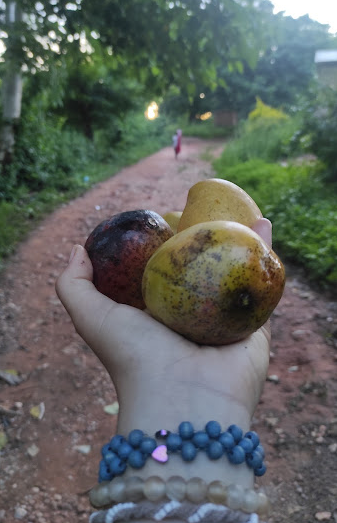
A few minutes later, the girl emerges from the curtain hung through the door frame carrying a basket full of mangoes, curtsying at us. The woman thanks the girl, takes a handful with her rough, swollen hands, and puts them gently in my lap. These are the hands of someone who’s worked day in and out in the fields, planting, cultivating, weeding, picking. I smile back, my heart melting in her generosity and openness, unable to find the words to thank her.
‘Thank you so much’ I mumble, looking at her straight in the eyes, only to see more kindness and love answering my feelings of appreciation and surprise.
The moment seems to freeze, and my mind’s eye is taking a turn to gift me a view of the scene from a distance, like a curious lens pointing directly at us. Here I am, resting in the garden of a kind and caring woman, who’s sweated in the stifling heat to collect those mangoes ready to be sold to the local fruit stalls or the market in town. And yet, she doesn’t hesitate for a second to share her hard-won efforts with a stranger rambling in the muddy path in front of her house.

‘Feel at home’ she gently adds, getting up and making her way through the curtain inside the shadows of the house. Left alone, I’m chewing away, feeling the humid breeze blowing in my direction, carrying with it the seeds of appreciation, connection and inspiration, planting themselves in my heart for what feels like a long time to come. The moment radiates a sweet crispness, full of possibility and positivity, acting as a lighthouse shining on the best of humanity. Kindness from a stranger to a stranger, hospitality in hard and deprived circumstances, and love shared unconditionally, invigorate me in a profound way, deeper than a swim ever could.
This afternoon has taken an unexpected turn, like a mountain changing shape every few meters, floating me from a sense of disappointment over the lack of connection to an unforeseen, heart-warming encounter on my way to the beach. I can’t stop thinking of the infinite possibilities that manifest themselves when I am open and willing to say yes to whatever life brings me.
Sat in the garden savouring the mango, the sun is going down and with it any feelings of shame, melancholy or loneliness that I was -inadvertently- nurturing in my heart. I smile, capturing the marrow of the moment as fully and completely as I can, embracing the richness that such unexpected encounters bestow upon me.

My mind is drifting back to the concept of privilege.
And this time, I realise something different.
Being here, in the garden of a loving woman living in the tropical green hills and sharing the delicate beauty of nature, is a true privilege.
And for it, I am as grateful as ever.