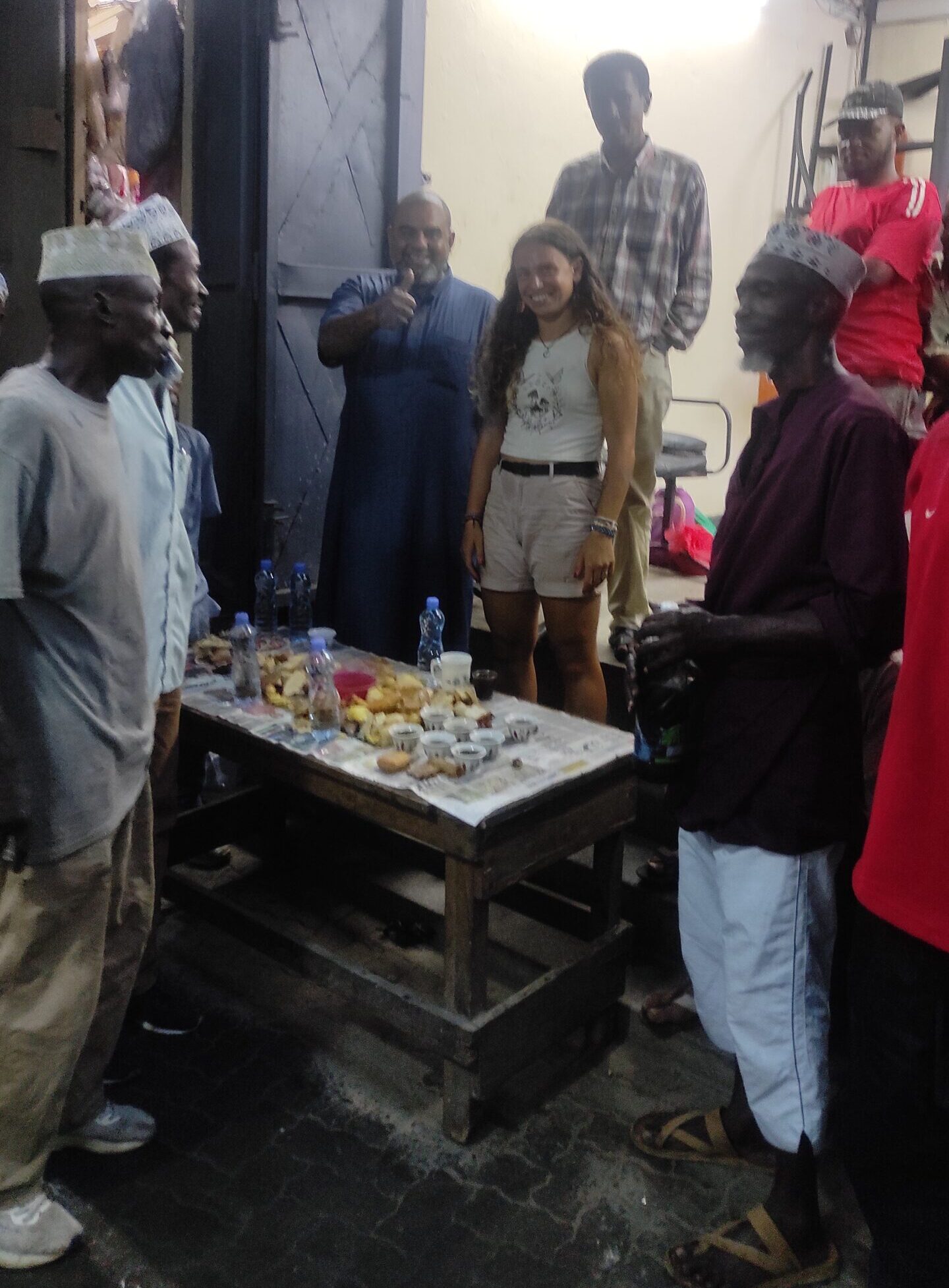
‘Karibu sana!’, the gentleman sitting in the middle of the bench calls out after me. I turn around to face him briefly without holding off my pace, and give him a happy smile in response to his welcome.
‘Asante!’, I thank him.
‘No, but come, come’ he continues, and a few others join in with him.
‘We are about to break the fast, please come and join us!’. The atmosphere in that small alley in Mombasa is getting lively and, among chattering and smiles, I shyly but very happily accept the offer to join a group of men as they have their first meal after a long day of fasting. I am honoured to be the lucky one to receive such an invitation!
It is the month of Ramadan in Islam, and a daytime fast (including water) from sunrise to sunset is broken at the end of the day in a collective and social way. Men gather together, prepare a variety of small dishes, mostly a selection of traditional bites, to enjoy at the end of long day before attending to their evening prayer. There’s coffee, juice and water too, and typically the first food to break the fast with are dates.

I was not going to turn down such a once-in-a-lifetime opportunity to join the men as they are breaking their Ramadan fast, and I am thrilled to have been welcomed to share this beautiful moment with them.
They quickly start shuffling around and offering their seats to me.
‘No please, sit!’ I am crying out multiple times, smiling and feeling my heart swelling up with the generosity and hospitality of these people. Meanwhile the rain is starting to fall ‘pole pole’ -slowly-, as the rainy season is soon to start in the south coast of Kenya. The drizzle is picking up, and after I convince them to move the table and the bench under a canopy, we are sitting back down again, me on one side of the bench, surrounded by about 10 Mulsim men eager to share their evening and openness with a young non-Muslim white girl wandering the alleyways of the Old Town in Mombasa on a warm and humid Wednesday evening.
In front of us, a table full of various Swahili dishes and delicacies, all chopped up in small bites ready to be shared. A tall thermos full of locally roasted coffee, accompanied by the small typical porcelaine cups that are used to sip the coffee in Kenya and Tanzania. They are white with intricately colourful decorations, normally flowers or rare birds, and are meant to be gently held in one’s palm, as they deliberately lack a handle. I have been in love with these traditional cups since I first came across them and I think they add incredible character to the experience of drinking coffee in a local coffee bar (I once even tried to convince a coffee vendor to let me buy one off him, but he firmly refused… I suppose he must have liked them as much as I did!).

‘What is this?’ I say curiously whilst pointing at a small round dough ball, looking a bit like a doughnut covered in sugar.
‘Mahambri’ the kind man who had firstly invited me over tells me. I suppose an English world would have been unnecessary (!) and would probably fail to properly describe the delicacy.
I am suddenly bombarded with a long list of Swahili words, as everyone eagerly joins in to educate me on the dishes in front of us.
‘Mitai’; another small doughnut-looking snack.
‘Mkate’; a type of thick wheat bread.
‘Tende’; dates.
‘Viazi’; small thinly sliced roasted potatoes.
‘Kabab’; a delicious ball of mashed beef meat, potatoes and eggs.
‘Mofa’; a ball-shaped mixture of bread and onions.
And that isn’t even half of the whole selection of the food on the table!
I suddently notice that while I am busy immersing myself in the gastronomical delicacies of Mombasa, the men are glancing at their watches. The daily fast is concluded at sunset, so we still have a few minutes to go. The street is getting livelier, and I can see the curiosity and slight confusion in the faces of the passersby. I am so happy to be here, and I keep thanking the men from the bottom of my heart.
‘You can start eating now!’. My conversation with the older man next to me is interrupted by the announcement that the time has come, and we can dive into the delicious bites in front of us. I pick up my steaming cup of coffee, visibly double in size from everyone else’s, and I take a sip. Warm, sweet and distinctive, it puts a smile to my face that reflects the inner joy I am experiencing. I put my cup down and pick up a date, absorbed in the conversations, the jokes and the family-like atmosphere that engulfs me. The men keep pushing dried fruit and mahambri into my palms, and when they realise I am struggling to keep up, they start piling up the bites in front of me. With my appetite growing, I savour every single bite of this most unexpected dinner. The rain has now stopped and the twilight is descending upon our small alley.

‘You eat too slow!’ the men joke about.
I heartily chuckle in between mouthfuls of food, struggling to keep up with the pace of the men around me.
‘I am going for prayer, but you take your time and enjoy the food.’ I am told by one of the gentlemen who are making sure I am well fed. ‘Hakuna matata.’ No worries.
As I am making my way into the last few dates in front of me, someone is pushing in my hand a round piece of what I assume to be another delicious snack wrapped in a page of a local newspaper. I lift my eyes up, confused and curious.
‘You have a long journey tomorrow, and you need to have something to eat with you’, one of the older men of the group points out to me, smiling with his eyes.
Quietly startled but so much moved by the generosity of these people, I thank him again and again. Still soaking in an ocean of gratitude, the man I first locked eyes with has brought me a full tupperware of pilau, an East African rice dish. Now I am really not sure how to accept this, considering it was probably the man’s dinner!
‘Now you don’t need to buy dinner!’ he says at me wittingly, sparking laughter and nods of approvement from our company.
I thank him profoundly.
‘Asanta sana. Thank you so much, I really appreciate it’ I manage to say, aware that it’s an understatement to the gratitude I’m feeling.
The crowd is now thinning as most of the men are rushing to attend evening prayer. After my efforts to try to help with cleaning are hastily shushed, I am accompanied by one of the men towards my hostel.
‘Take care when you walk, just don’t mind anyone and go to your hotel’, he says carefully and attentively to me as we keep walking.
‘I’ll be careful, I promise’, I assure him confidently.
After we exchange a very warm handshake and many wishes, we part ways as he is entering the mosque and I am continuing to my hostel. The streets are buzzing now, mostly from men and women returning home after their prayers. The rain has stopped, and the lights reflected through the water droplets give the streets a warm glow. The architecture is beautiful, with curved openings in the walls, intricate carved doors, whitewashed buildings and many decorative touches blending Arabic, Portuguese, Indian and British elements in a unique colonial fusion of cultures. The city is calm but vibrant, welcoming but intriguing. The narrow alleyways scatter throughout the old town, sometimes only a meter wide, inviting you to get lost exploring them.

Later on, I am sat in the Andalucian-like patio of a hostel overlooking the water, letting the warm breeze carry with it esoteric reflections about this place. Mombasa is a predominantly Muslim city in the south coast of Kenya, its climate very warm and humid, making for a summerlike feeling all year round. The only exception are the heavy rains from March to April, which have gently started making their appearance in the cloudy skies and sporadic showers. I am impressed by the hospitality of the people here. Earlier today on the street, I was offered an entire cold bottle of water for free by a beautiful woman with sharp eyes, refusing my repeated offer to pay. Later, I managed to convince a coffee vendor in the local coffee bar to let me pay for the coffees I had, after we exchanged the basic information about each other and therefore we were already considered friends.
I had no idea I ever could or would get invited to break the Ramadan fast with a group of men, let alone be given takeaways for the road! As a non-Muslim woman dressed with a modest outfit, but still revealing enough compared to the majority of Muslim women in Mombasa, I didn’t know whether my presence there would cause any interesting or thoughtful glances, and I certainly didn’t want to insult anyone, especially in the holy month of Ramadan. I needn’t have been concerned with this at all.
I felt so welcome in that alleyway surrounded by Muslim men, and respected for who I was. I was not treated or spoken to any differently for not being Muslim. On the contrary, I was treated with immense generosity and was welcomed as if we were family. They opened the doors to one of their strongest traditions, inviting me to share it with them, explore its intricacies and experience the nature of their abundant generosity and love first hand. They shared their dinner with me after a full 13 hour fasting period, and they did that with generosity from the bottom of their hearts. I was so warmly welcomed, I really didn’t have the right words to thank them. Their loving gesture showed me how much they appreciated hosting someone and treating them with love and respect.
Ultimately, kind nature and generosity surpass gender, religion, nationality, age and status, and experiences like these really push us to examine our own behaviours and values, and inspire us to be the best version of ourselves.
