The sun is a very deep orange, like an evening fire nearing the end of its life.
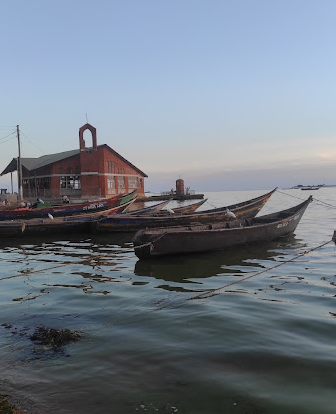
It glows dimly through a soft, diffused veil of cloud. It’s as if someone has laid an orange sheet across the sky. A gorgeous coral hue, tinting the water with the most unusual palette. The water is calm, with a gentle ripple decorating its surface. Yet it moves quickly, as if in a hurry. To go where, I wonder?

A pink net spreads across the surface from the sun’s reflection on the water. All the boats are facing towards the horizon, letting the viewer’s thoughts drift across the way the lake’s imposing birds are endlessly spreading their wings. The shacks are waving too, their walls built from windswept horizontal planks of local wood and their roofs from jugged corrugated metal. They are swaying left and right, as if someone is pushing them, trying to topple them. But they don’t show any signs of defeat; they resist the passage of time and the force of the elements. Faded, like the boats that surround them from every direction.
As I am spending the Christmas holiday in the lakeside village of Kigungu in Uganda, I am learning that many of these shacks belong to people who once lived in one of the lake’s islands, but were forced to move because of the rising water level. I’ve never seen a camp like this with my own eyes, and I feel a kind of awe as I am mustering my courage to walk across it. An evident outsider, I am attacting all sorts of glances, ranging from excitement and curiosity to hesitation and intrigue. It’s the first time I am hearing, with my own ears, a real example of people who have had to leave their homes because of rising water levels, and a tightness grips me like a snake crawling around my neck. What would it be like if we were the ones who had to—or were forced to—do the same?

The sun is perfectly round, a beautiful pink-orange colour and a shape as clear as the moon. Its outline flawless, a full circle, as it prepares to offer us its last smile before slipping behind the soft greyish blue clouds that always decorate the horizon at this hour of the day. I’ve always loved watching the sunset—observing its speed, its colors, the rays, the way it adorns the world. Accompanied by the lapping of the water, I truly feel as though I’m in Greece in the summertime, sensing an intimate nostalgia spread across my body. Some 6,000 miles from home, the distance doesn’t feel only physical, but also emotional.

A boat approaches us. You wouldn’t think it, but these boats can hold at least twenty men; they’re fairly big, about six or seven meters long, and roughly two meters wide.

How much do places matter on their own? How much does it matter where we are, where we’re going, if we strip away the emotional value that a place gives us? How deeply would this landscape touch me if it weren’t tied to numerous childhood summers -which own an unparalleled place in my heart and memory- my family, and all the memories of growing up around the sea? Memories of every kind: exciting school trips, extracurricular programs, loving grandparents, long summer camps, strong friendships, caring parents, mischieving siblings, laughter, meals, chases, running, sweat, breath, vitality, courage, rest, renewal.
And that’s why water moves me so much. Being near it touches me in a way I can hardly describe, able to access a part of my soul which remains hidden for the majority of time.

Another fisherman sets out. New Year’s Day or not, poverty doesn’t recognize holidays. Poverty doesn’t distinguish special days. The work continues without pause, day and night, because work means survival. It means caring for one’s family, rising to meet the demands of circumstance and the expectations of society and relatives.
And just like that, the new year has begun…