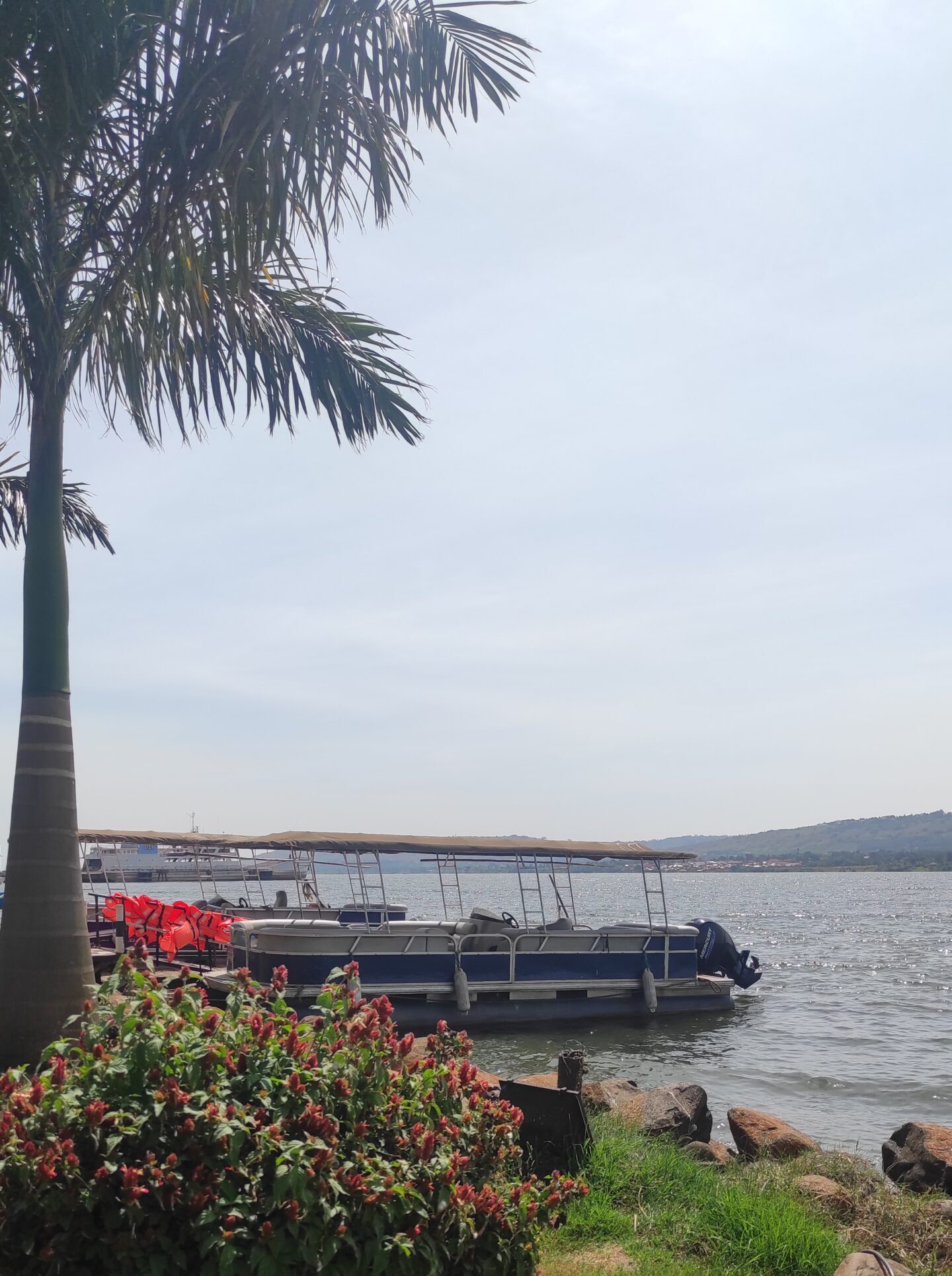
December the third, eastern bank of the Nile. Barefoot, in a pair of colourful shorts and a light, airy T-shirt.
The grass underneath my feet, yellow-green but vibrant, connects me to the fertile African earth. Sweet black coffee -local, from the highlands of Uganda-, and a sun that is gentle, soft, yet playful—one that lightly dazzles you and invites you to enjoy its warmth upon your skin. A mild south-westerly breeze is blowing, carrying closer the hum of engines from the tourist boats shuttling visitors to and from the source of the Nile, like bees wheezing about. I seize the moment, filled with gratitude and joy, yet also with a deep contemplation -something that seems inseparable from my experience in Africa over the past three weeks.

Seated two or three meters from the water, with a vantage point that hides the Nile’s northern course, I feel as though I am in the bay of Porto Rafti in the eastern coast of Attika in Greece in early July, sipping coffee and savouring the summer sun. From here begins the gentle expanse of Lake Victoria, and although the water is fresh, I can sense in my nostrils that familiar scent of sea and fish. A scent I carry so deeply in my heart, one that never fails to grant me a lightness and a joy I struggle to put into words.
On the horizon, I make out low, lush green hills, dotted with a variety of crops of every kind: bananas, mangoes, jackfruit, cassava, maize, beans, tomatoes, and other trees and plants I wish I could name.

Fortunately, the café in which I am sitting is not particularly crowded today, and for the past hour or two I have been talking with the waiter.
I continue to be struck by the people of Uganda – by how open they often are, and how easily we can speak candidly about many subjects, including religion, gender, race, nationalities, society, history, and contemporary issues. I learn from locals that many Ugandans are not particularly open, which makes me feel that I am drawing upon me a certain kind of luck, through which I meet and connect with a wide variety of people, on many different levels.
Shafik, the waiter keeping me company, is twenty-one years old and carries himself with a maturity way beyond his years. A Muslim, with an especially gentle presence that inspires respect, dignity, and kindness, he seems to look at life through the lense of curiosity and intelligence.
He grew up with his grandmother and his six younger siblings, without any contact with his parents. The only connection is mediated through his grandmother, should they need some form of financial assistance at sporadic intervals.
From the fifth grade of primary school onward (primary education in Uganda lasts seven years), his grandmother could no longer afford to pay the school fees (many schools in Uganda charge some modest tuition). Through his own effort, Shafik managed to secure a scholarship for the following six years, until he completed school and could move on to some form of college, in order to gain knowledge related to his field and eventually enter the job market.
When I meet him, he is spending his holidays (a two-month break from early December to early February) as a trainee at the café where I am having coffee. He begins our conversation by telling me that he hopes to save enough money to return to school for the next term, though he doubts whether he will manage. He radiates a quiet passion for life and for education, coupled with determination and uncertainty about the future.

Shafik’s story is not rare in Uganda. On the contrary, it is one of the many similar stories I have heard over the past two weeks – stories soaked in poverty, abuse, abandonment, and the absence of parental figures from children’s lives. Children who have done nothing wrong, children who solely seek love and support from their parents.
I am telling him excitedly about the very recent vision Sylvia (the director of the school where I had been staying) and I share: to collaborate in the creation of an orphanage. He looks me intently in the eyes and the response is soft, yet firm.
‘That would be wonderful. The way we grew up was not right.’
He doesn’t need to say anything more. I have seen and heard enough these weeks to imagine that these children have experienced and witnessed things unbefitting their innocence and age. And yet, amid the hardship, there is a humanity in the air that touches me – a sense of shared humanity that truly binds us all.

Later, I show Shafik where Greece lies on the map, and I see joy in his eyes, accompanied by curiosity.
‘Have you ever met someone from Greece before?’
The answer, as expected.
‘No, I’ve only heard of it.’ The honor of introducing my country to a young man from Uganda who is striving to secure a good quality of life and education for himself brings tear to my eyes, and a certain sense of responsibility and duty towards him.
Time passes, and my gaze drifts to the gentle rippling of the Nile. Cormorants dive incessantly – they are astonishingly agile and swift. I catch sight of small fish in their beaks – no matter what, the cycle of life does not stop.

Having time to speak and socialize with the locals shifts my perspective on Africa. I see the poverty; I see the hardship and the toil that etch so many lives.
At times I feel indignation, anger, and perhaps a measure of despair at how we have failed collectively, on many levels, as a society, to satisfy basic human rights.
And yet, this indignation is intertwined with the joy and freedom I have been feeling. And how could it not be, when I’m witnessing such effort and striving, when I’m acknowledging such genuine humanity and support, arising from every kind of socio-economic background?
I’m not sure how much time has passed, but the moment comes when my thoughts are carried away by the gentle breeze blowing over me, its intensity going down as the day is coming to a closure. The sun reaches its zenith and the air stills. My coffee is now cold, but my heart is full of warmth.