The wind sweeps a few stray strands of my hair as we cross, on the boda boda, fields full of rice, maize, and banana crops. Apart from the entirely different and endlessly lush vegetation, the landscape reminds me of England’s geomorphology – gentle hills rolling like waves to our right and left, with sprawling fields in every shade of green.
There are three of us on the motorbike, with me in the middle. It’s a little before ten in the morning, and we’re headed to a nearby village, some seven or eight kilometres away. In East Africa, distances are measured by the time it takes you (by car or motorcycle) to get somewhere, and so, unless I check the map on my phone, I rely solely on my own estimates. I’ll be spending most of my days there over the next few weeks, in the project where I’m supposed to run a short ten-day meditation course (spoiler alert: at least, that was the plan!) for a group of women supported by the organisation hosting me.


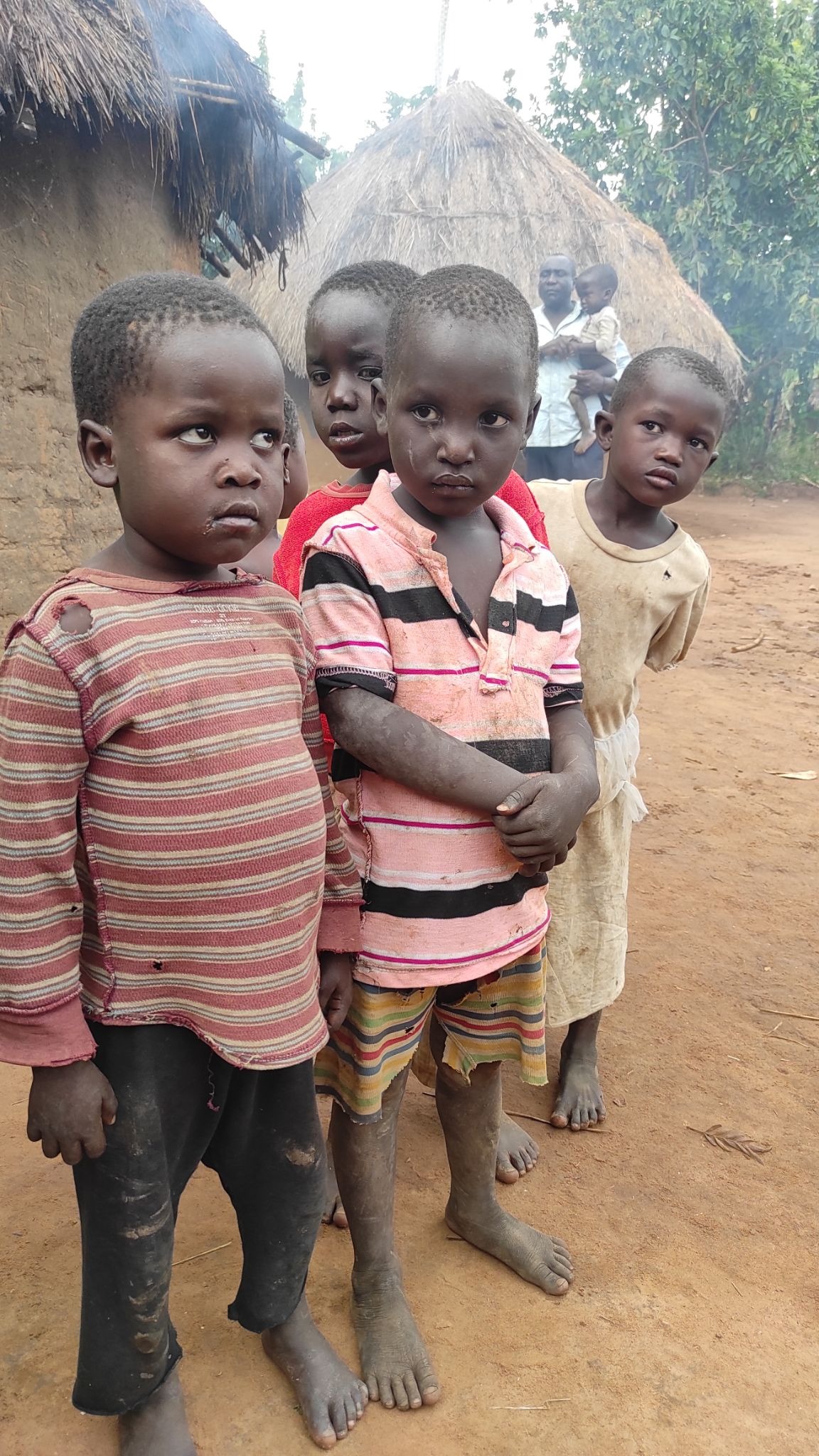
Life in the village is marked by poverty, simplicity, and a strong sense of connection. People open their doors to me and invite me to explore their homes, their community, their animals, and their families. I notice many huts, which often house the boys of the family, or are used as storage rooms, or even as small chicken coops – chickens being one of the animals many people raise. I learn that sometimes entire families share a single hut if they cannot afford anything more.
Brick or cement walls, with roofs made from compressed rice plant straws and dried banana leaves, or in some cases, corrugated metal sheets.

All around, turkeys with their chicks (I’ve never before stroked two-week-old baby turkeys -they’re very cute). Scattered everywhere, the now-familiar yellow jerrycans.

I see boreholes often, and I can’t imagine there’s ever more than a kilometre – or at most a kilometre and a half – between two of them. Crowds of children gather around them; they seem to function almost like village squares, places where news and laughter are exchanged.

Our motorbike passes in front of them, honking now and then at chickens straying into the road. Suddenly, jerrycans are set down with a soft thud, and the sound of the well’s pulley stops. It seems that the importance of daily water collection can shift in an instant, and children drop whatever they’re doing the moment they realise there’s a mzungu on the boda!

Mzungu (pronounced “moo-ZOON-goo”) refers to white travellers in Africa. The reactions of the locals vary, but are (nearly always) well-meaning. A sudden shock that freezes the gaze and gives the eyes a look of playful curiosity. Surprise, accompanied by a huge smile and widened eyes. Excitement, and joyful greetings—“How are you?!” and “Mzungu, mzungu!” Shy smiles, carefree smiles, thoughtful smiles like half-smirks. Today, as every day even after many weeks, I feel as though I’m modelling through crowds of people. For a long time I’ve been feeling that a respect is granted to me because of the colour of my skin, before I’ve earned it through who I am.
Slowly, I’m trying to counter some of the stereotypes about white people – deeply rooted in these societies. Many people here never see any white people, especially if they never leave their village, so seeing me can feel rare and remarkable. Children will run to touch me, and (as I learn) may refuse to wash their hands afterward so as not to lose the “good luck,” as locally perceived, that comes with touching a white person. I know it might sound strange, but we shouldn’t forget how many people in East Africa hold a great—sometimes excessive—respect for white visitors, and how their curiosity sparks every time they have the chance to interact with one.

I am chatting lively with Rebecca, pausing to shield our faces from the dust kicked up by passing motorcycles, and also to laugh at people’s enthusiastic reactions. For Africans, the terms “black” and “white/mzungu” are normal, as matter-of-fact as we might say “blond” or “brunette,” without the slightest hint of offence. For them, it’s simply a characteristic, a truth, with no further implication. So it becomes very easy for us to use these terms constantly in our conversations, as we compare lifestyles, perceptions, and habits.

Similar to the wells, gatherings also form around clusters of houses and huts. Around five or six homes, there is usually a small clearing – a kind of “little square” – and perhaps a mango or avocado tree offering thick shade year-round. Under the trees, seated on the glowing brown earth, women with babies and children of all ages, and men when they’re not working. Babies are carried in the African wrap, in which the child lies on their front on the mother’s back (in general, only mothers carry children in Africa), with the head turned right or left. I see this system constantly, and suspect it’s preferred because it leaves the mother’s front free – essential for cooking, carrying water, and all the other daily, often non-stop, household tasks women perform.

I notice that socialising is woven directly into daily life, and in fact into the rhythm of the day. For most of us, work is separate from social life or personal life. But in rural African living, this artificial distinction often doesn’t exist. People – those who don’t work outside their neighbourhood – interact frequently throughout the day, in-between cooking, fetching water, and other household tasks.

Spending time in East Africa, I quickly realise that the neighbourhood is incredibly tight-knit, sometimes even bound together like a family, especially in small, tucked-away places.

We continue crossing fields under the morning African sun, and I talk with Rebecca about village life. I realise – and am not surprised – that most houses have no electricity, relying instead on small torches or kerosene lamps for indoor light. Sometimes even small candles. Electricity simply isn’t part of the family budget. In other cases, there’s a single outdoor light serving a small cluster of four or five homes or huts. These lights are solar-powered, so they add no extra cost and, of course, charge all day long (especially in the dry season, like now, when the sun shines brightly throughout the day). Walking at night in some of the very rural, isolated areas, I realise that in many places there is no electricity at all. You might wonder – how do people charge their phones? How do they cook? TV? (On that last one, I’m joking.) Most people in these rural areas live day to day, from wage to wage. Technology is not part of life, which often contributes to the persistence of stereotypes and superstitions (more on this later). Many people here do not have mobile phones and socialise only with those in their immediate surroundings. Most, however, do have phones, and especially here, many use button phones (yes, it had been a while since I’d seen those!). Cooking is done outdoors, in a kind of barbeque setup, over charcoal or wood (wood is cheaper and therefore more common).

Africans are known for their hospitality, but their hospitality towards white visitors is unparalleled. I realise this when we reach our destination. Women are waiting for me – an entire group – with a cloth banner announcing my arrival and welcoming me into their team. Lively songs with throaty cheers, loud rhythmic clapping, and traditional dances – into which I quickly join! I feel moved, and wonder what I’ve done to deserve such a welcome. I soon understand, though, that for many Africans from the lowest socio-economic statuses, hosting a visitor from faraway lands – lands which, in their minds, are wealthy, advanced, and almost exotic – is not only noteworthy, but often a unique opportunity. They see it not only as a privilege that a white person would be willing to enter their way of life and their community, but also as an extraordinary chance to ask about life in those faraway places, to be inspired, to clear doubts, and to open their minds. I’m struck when I hear this, though not entirely surprised. For me, this is one of the reasons I travel: to discover the smaller places, the most isolated people, the most hidden villages, the most intense gazes – to feel them, recognise them, understand them. This is how I expand my horizons, become humble and, I hope, a better person.
