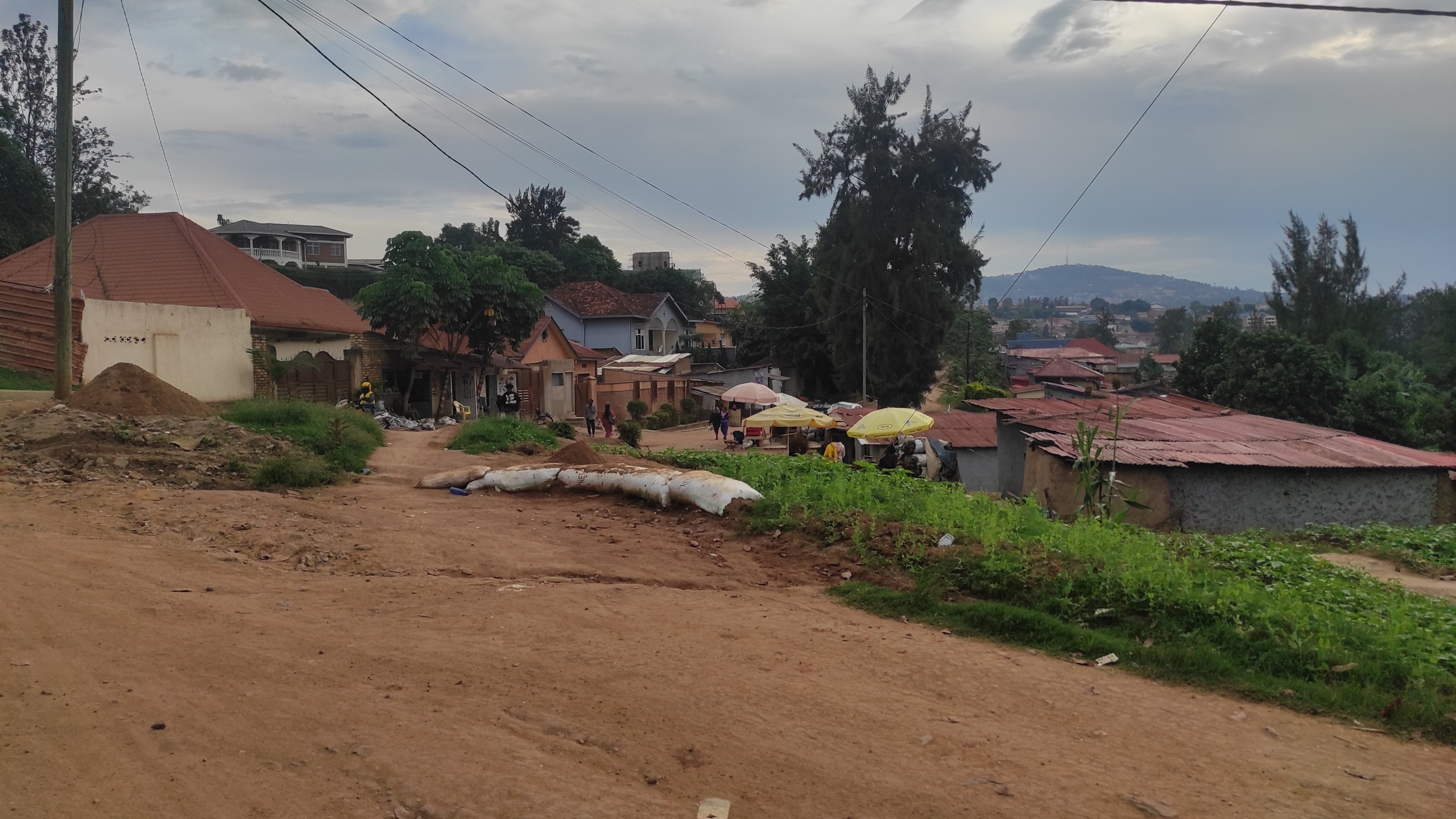
As I passed an area of beautiful houses with iron gates and lush gardens, within a couple of meters the road suddently went from tarmac to a red-ish brown ground. Now the houses have metal corrugated roofs, hastily put together into something that resembles the shape of a house. I suddenly realise that everyone on the road has turned around to have a look at me. I seem to have stumbled into a slum.
…
One of the things that has fascinated me about Kigali, and Rwanda in general (but especially the busy capital of Kigali) is how clean the roads are. My Rwandan friend Desire is telling me that there are daily morning clean-ups by public health employees (which I have observed on different occassions very early in the morning), as well as monthly community voluntary clean-ups to keep the roads clean. Many roads were spotless, even in areas with high poverty, with absolutely no rubbish on the ground, no stuck chewing gums (unlike my country…), and no pieces of plastic wrappers or cigarette stubs.

All takeaways come in paper grocery bags, and all takeaway cutlery are bamboo, not plastic (Desire also told me that being found to give out a plastic fork will incur a fine of roughly £250!). There are also big campaign posters encouraging people to bin rubbish and not throw them on the floor. I keep wondering whether some of our European cities could ever be that clean.

Yet, I can’t help but notice the contradictions that are evident in this beautiful country (as well as many other East African countries of course).
On a hot humid day, I was exploring an area on the east of Kigali, and (after negotiating with about every single shop for a cheap lunch!) I decided to walk back to my hostel, rather than take the usual moto-taxi. Walking in foreign places is something my family has taught me to appreciate. I find it a special experience, allowing you to explore where and how the locals live, aside from the busy hustling roads. And, this is exactly what was waiting for me…

As I passed an area of wealthy-looking houses with gates and beautiful gardens, suddenly the road went from tarmac to a deep red-brownish ground. The houses have now got metal corrugated roofs, hastily put together to resemble the shape of a house and protect the residents from the elements. I suddenly realise that everyone on the road has stopped their activities and turned around to have a curious look at me. I keep feeling I have accidentally entered a private place, a place that I’m not supposed to have been at, hidden away by the shade of the clean and tidy Kigali.
I then realise that I seem to have stumbled into a slum. An area of underdeveloped living, with very low living standards, potentially lack of electricity and minimal hygiene.

The rays of the afternooon sun are penetrating through the clouds and there is a playful feeling in the air. I can sense that people seem to be intrigued by the presence of a foreigner in their neighbourhood. I keep hearing laughter, whispers and the occasional ‘hey sista how are you’, or ‘you’re beautiful sista’, or ‘mzungu’ (Swahili word literally meaning ‘wonderer’ or ‘lost’, typically used to refer to white foreigners).

I keep walking ahead, taking the environment in while listening to some sweet reggae, almost unable to believe what I’m being exposed to and fascinated by the other side of Kigali that I have had the unique opportunity of seeing and walking through.

The road curved around offering a beautiful view of the southwest side of Kigali, and I keep exchanging smiles, playful glances and hellos with the residents. My attention is suddenly captured by a large construction site on my right hand side. As an electrical engineer having worked in the construction industry, I naturally tend to observe such details. But this construction site is a little different and I have to pay close attention to check whether what I’m seeing is what I think it is.

The scaffolding is made out of long thin branches of trees (I couldn’t figure out how they were secured together).

A lot of the employees seem to be women, which are carrying stones in the traditional African way, i.e. mounted in their head, supporting it with their hands either side (hands without gloves of course). And, I can see a lot of them in flip-flops.

Even though I understand the different ways of doing things in Africa, and there are so many beautiful things I love about this land, I have to admit I was very apprehensive when I saw that, probably because this is an industry I have spent 3 years working in and therefore it’s very close to my heart and always at the forefront of my mind.
It made me wonder how many serious life injuries or deaths occur in construction sites in Rwanda. Doing some quick research – not particularly fruitful as I am struggling to find information – I came across a research paper from 2013 which indicated that 482 non-fatal and 6 fatal accidents occured across a total of 780 man-months in Kigali. This averaged to about 0.6 accidents a month, across those 23 sites which were investigated. The paper was produced by a survey of 130 construction workers and only concerning those 23 sites, which makes me think that the number is likely to be higher if we accounted for a larger number of workers, cities and construction sites.
Of course construction is not the only precarious occupation – I couldn’t snap a picture as the road was extremely bumpy and our car especially rattling – but I will never forget seeing a man on a bicycle towing himself by holding on to a lorry. And this was on a busy road doing about 40-50 km/hr.
I consider every one of my days in Africa to be very special. But I experienced an interesting multitude of emotions that day, ranging from a deep sense of sadness, concern and curiosity. I have observed poverty before, but there was something that felt different about entering that unique and private place of the slum. It also recirculated a mental theme which is always going round in my head, that of opportunity, different life circumstances and priviledge.

As I am continuing to explore Kigali, I keep thinking that maintaining an open heart, a flexible mind and a prevailing sense of curiosity are indispensable when it comes to those experiences. Because only then can we allow a place give us all that it has to give us, teach us all that it has to teach us, and ultimately, enrich our experience of life in completely unprecedented ways.